READ ALSO: Days of the Week in Swahili
Jumamosi in English/Jumamosi Meaning/Jumapili Jumamosi/Juma Mosi in English
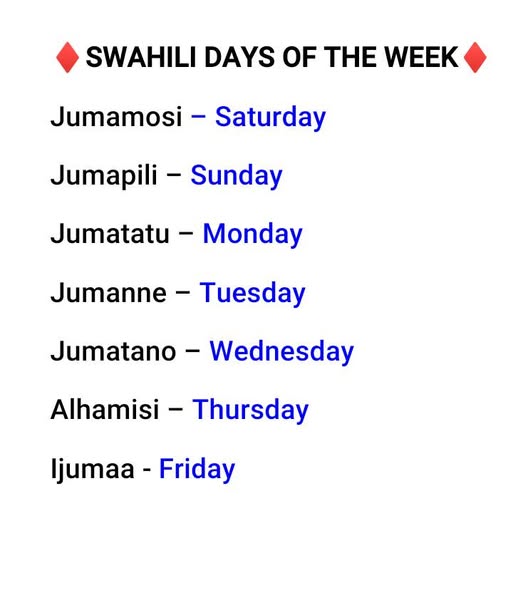
The first day of the week in Swahili culture is Saturday or Jumamosi (‘day one’).
If you can remember this main difference in how the week is structured in Swahili vs. English, this will go a long way in helping you learn and remember the days of the week in Swahili.
Table of Contents
Apa Itu Jumamosi
Jumamosi adalah kata dalam bahasa Swahili (Kiswahili) yang berarti “Sabtu” dalam bahasa Indonesia.
Menariknya, kata Jumamosi berasal dari:
- juma = minggu
- mosi = satu
Jadi, secara harfiah Jumamosi berarti “hari pertama dalam minggu.” Dalam sistem penamaan hari dalam bahasa Swahili, Sabtu dianggap sebagai hari pertama dalam minggu.
Contoh:
- Leo ni Jumamosi. = Hari ini hari Sabtu.
- Kesho itakuwa Jumamosi. = Besok hari Sabtu.
Jadi jika Anda menemukan “Apa itu Jumamosi?”, jawabannya adalah: Jumamosi adalah bahasa Swahili untuk hari Sabtu.
READ ALSO: How to Express Costume in Swahili Accurately Today in 2026 & More
Jumamosi Language
Jumamosi is Swahili for Saturday.
Palm Sunday in Swahili (& Jumapili in English)
Palm Sunday in Swahili is commonly called “Jumapili ya Matawi.”
- Jumapili = Sunday
- Matawi = branches (especially palm branches)
So the name literally means “Sunday of branches,” referring to the palm branches used during the celebration.
Palm Sunday, or Jumapili ya Matawi, is an important day in Christianity.
It falls on the Sunday before Easter and marks the beginning of Holy Week.
On this day, Christians remember when Jesus Christ entered Jerusalem and was welcomed by crowds who waved and laid down palm branches in his path as a sign of honor and praise.
In many Swahili-speaking communities across East Africa, including Tanzania and Kenya, the celebration has a very recognizable style. Churches often hold processions where people walk while holding palm leaves.
These leaves are usually blessed during the service. Afterward, many people take them home and keep them as a symbol of faith and blessing.
In Swahili church language, you might hear phrases like:
- “Yesu aliingia Yerusalemu kwa shangwe” (Jesus entered Jerusalem with celebration)
- “Hosana!” (a word of praise also used in the Bible accounts of the day)
The meaning behind Jumapili ya Matawi goes beyond just the branches.
It represents humility and peace. Jesus entered the city riding a donkey, not a horse, which symbolized that he came as a peaceful king rather than a warrior.
In Uganda and other parts of East Africa, it is common to see people carrying fresh palm leaves to church early in the morning.
The atmosphere is often lively, with singing, prayers, and sometimes outdoor processions.
The day also prepares Christians for the events that follow during the week, including Good Friday and Easter Sunday.
In simple terms, Jumapili ya Matawi is:
- A day of remembrance
- A day of celebration
- The beginning of the most important week in the Christian calendar
Mosi in Swahili
The Swahili word mosi has a few related meanings, depending on how it is used.
Although it is less common in everyday speech than moja, it remains an important word in Swahili vocabulary and appears in names, dates, and traditional expressions.
The primary meaning of mosi is “one” or “first.” In modern Swahili, moja is the standard word for the number one when counting or describing quantity. For example:
- Nina kitabu kimoja. – I have one book.
- Moja, mbili, tatu… – One, two, three.
By contrast, mosi is generally used in more specific or traditional contexts rather than ordinary counting.
Photo credits: Kiswahili With Abdulkarim