The phrase “Powered by BlogEngine” health tips leave a comment is an interesting combination of words that you may encounter when searching for health-related blogs on Google.
Although it looks like the title of a health article or a particular health website, it actually combines several elements commonly found on older blogging websites.
Understanding this phrase requires looking at three things: BlogEngine.NET, health tips published on blogs, and the comment sections that allow readers to participate in discussions.
If you have come across this wording in a Google search, you may be wondering whether it refers to a particular health blog, a health advice platform, or a website where readers can share their opinions.
Here is what you need to know.
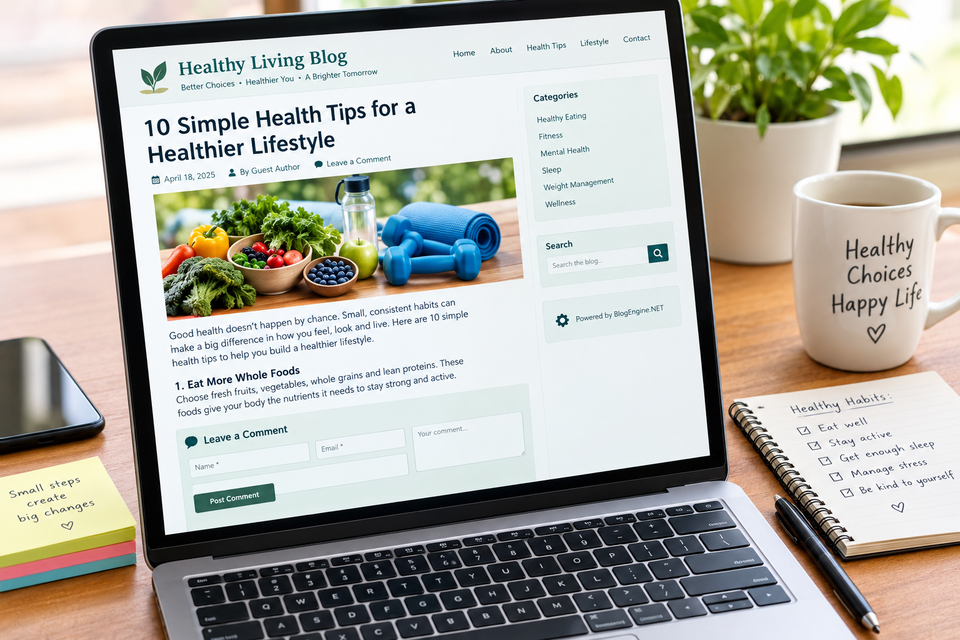
Table of Contents
What Does the Powered by BlogEngine in ‘Powered by Blogengine” Health Tips Leave a Comment’” Mean?
Powered by BlogEngine is a reference to BlogEngine.NET, an open-source blogging platform that allows individuals and organisations to create and manage blogs.
BlogEngine.NET was developed using Microsoft’s .NET technology and was particularly popular among bloggers who preferred building their websites using Microsoft’s web development ecosystem.
Rather than writing all the code required to build a blogging website from scratch, website owners could install BlogEngine.NET and use its existing features to publish articles, organise content and manage readers’ comments.
Some of its main features include:
- Article publishing: Website owners can write, edit and publish blog posts.
- Categories and tags: Articles can be organised into relevant subjects.
- Comment management: Readers can leave comments, while administrators can moderate submissions.
- Themes: Website owners can change the appearance of their blogs.
- Plugins and extensions: Additional functionality can be incorporated into the website.
- RSS feeds: Readers can follow newly published content through feed readers.
The phrase Powered by BlogEngine.NET usually appears in a website’s footer, identifying the software used to operate the blog.
It does not identify the website’s owner, the author of an article or the subject matter of the blog.
What Are Health Tips on BlogEngine Websites?
BlogEngine.NET is a publishing platform rather than a health information service.
This means that a website running BlogEngine.NET could publish practically any subject, including technology, travel, education, personal experiences, lifestyle advice and health information.
A health-focused blog using the platform might publish articles about:
- Healthy eating and balanced diets.
- Exercise and physical activity.
- Sleep habits and improving sleep quality.
- Mental health and emotional wellbeing.
- Personal hygiene.
- Weight management.
- Preventive healthcare.
- Everyday habits that support general wellbeing.
For example, a blogger might publish an article explaining the benefits of eating vegetables regularly, the importance of drinking sufficient water or ways to incorporate physical activity into a busy schedule.
The blogging platform provides the tools to publish this information, but it does not automatically verify the medical accuracy of the articles.
This distinction is important.
A health article appearing on a BlogEngine.NET website should be evaluated according to the qualifications of its author, the quality of its information and whether its medical claims are supported by reliable evidence.
What Does Leave a Comment in “powered by blogengine.net” health tips leave a comment site:chickabouttown.com Mean?
The words Leave a Comment are generally an invitation for visitors to respond to a published blog article.
Blog comments allow readers to participate in discussions rather than simply reading information and leaving the website.
On a health blog, for instance, readers might use the comment section to:
- Ask questions about something discussed in an article.
“Powered by blogengine.net” Health Tips Leave a Comment
If you would like to know what this phrase means, click here.
‘Powered by Storytlr” Health Tips Leave a Comment’”
The phrase “Powered by Storytlr” health tips leave a comment brings together three elements commonly found on older blogging and personal publishing websites: a blogging platform, health-related content and an invitation for readers to leave comments.
If you have encountered this wording in a Google search, you might be wondering what Storytlr is, whether it is a health information website, and why the words Health Tips and Leave a Comment appear alongside its name.
The important distinction is that Storytlr is a publishing platform, not a healthcare organisation.
Understanding its original purpose helps explain why its name might appear on webpages containing health-related information.
What Is Storytlr?
Storytlr was an open-source lifestreaming and microblogging platform developed to bring a person’s online activities together in one place.
It was designed around an interesting idea: instead of having separate websites for blog posts, photographs, bookmarks, music preferences and social media updates, people could collect these activities on one personal website.
For example, someone could use Storytlr to bring together:
- Blog entries published on different websites.
- Photographs shared through online photo services.
- Updates posted on social networks.
- Links to interesting articles.
- Music-related activity.
- Personal status updates.
- Other online activities that could be imported from supported services.
The result was a chronological stream of a person’s online activities, presented on a single website.
This type of publishing became known as lifestreaming.
Storytlr was particularly interesting because it allowed users to create a personal online presence without depending entirely on the profiles and layouts provided by individual social networks.
It also included a feature called Stories, which allowed users to combine selected online activities into a more organised account of an event or period.
For example, someone documenting a holiday could bring together photographs, blog posts and other updates to create a single online story.
Storytlr was developed by Laurent Eschenauer and Alard Weisscher, two developers based in Belgium and the Netherlands.
2. What Does Powered by Storytlr Mean?
When you see Powered by Storytlr at the bottom of a webpage, it generally identifies the software used to create or operate that website.
It is similar to seeing Powered by WordPress or Powered by Blogger on another website.
The phrase does not mean that Storytlr owns the website or writes its articles.
Instead, it indicates that the website uses Storytlr’s publishing technology.
This distinction is important when interpreting search results.
For instance, a website might publish an article titled Simple Health Tips for Everyday Living.
At the bottom of the page, it might display:
- Leave a Comment
- Powered by Storytlr
- Copyright information
These elements serve different purposes.
The article provides the health information, the comment section allows readers to participate, and the footer identifies the publishing software.
Consequently, a search for the combined phrase ‘powered by Storytlr health tips leave a comment’ might bring up a webpage containing all these elements without the phrase being an actual article title.
Why Would a Storytlr Website Publish Health Tips?
Although Storytlr was designed primarily for lifestreaming and microblogging, its publishing capabilities allowed users to share different types of information.
A person using the platform could publish personal observations, opinions, links and longer-form posts.
Health was one of the many subjects that a user could choose to discuss.
A Storytlr-powered personal website might therefore contain articles about:
Nutrition: Discussions about balanced diets, fruits, vegetables, whole grains and healthy eating habits.
Physical activity: Posts about walking, running, cycling, exercise routines and the benefits of remaining physically active.
Sleep: Articles about establishing regular sleeping patterns, creating comfortable sleeping environments and developing better bedtime habits.
Mental wellbeing: Personal discussions about managing everyday stress, maintaining social connections and making time for relaxation.
Personal hygiene: Information about handwashing, dental care, bathing and other everyday hygiene practices.
Preventive health: General information about routine medical check-ups, vaccinations and recognising when professional medical attention is necessary.
The important point is that Storytlr does not specialise in any of these subjects. The website owner determines what gets published.
A health article hosted on a Storytlr-powered website should therefore be judged on the quality of its content rather than the name of the software appearing in the footer.
What Does Leave a Comment Mean on a Storytlr Website?
The expression Leave a Comment is an invitation for visitors to respond to a published post.
Commenting is an important feature of interactive blogs because it allows readers to contribute to discussions and communicate with the website owner.
On a health-related webpage, visitors might leave comments to:
- Ask questions about the information in an article.
- Share personal experiences.
- Discuss lifestyle changes.
- Recommend additional reading.
- Offer feedback about the article.
- Point out information that needs clarification.
Imagine a blog publishing an article about the benefits of walking every day.
A reader might leave a comment explaining how regular walks have helped them establish a consistent exercise routine.
Another reader might ask whether walking for 20 minutes provides any health benefits.
These exchanges can make a blog more interactive and give the author an opportunity to clarify information.
However, comments are not automatically reliable medical advice. Personal experiences should not be treated as evidence that a particular treatment or health practice will work for everyone.
Whether visitors can comment also depends on how the website has been configured.
Some websites allow immediate publication, while others require the administrator to approve comments before they appear.
5. Is Storytlr Still Available?
One interesting aspect of Storytlr is that it belongs to an earlier generation of social publishing platforms.
It emerged during the period when people were experimenting with ways to bring their online activities together rather than maintaining separate social media profiles.
Storytlr attracted attention because it offered an alternative to conventional blogging platforms and social networking websites.
However, its original hosted service is no longer an active mainstream blogging service. The project has also become unmaintained.
The original software was released as open-source code, allowing people to install and experiment with it on their own servers. Historical documentation describes its use of PHP and the Zend Framework.
There is an important qualification, though. The software relies on outdated technologies and components.
Running an old installation on a publicly accessible server can create security risks.
Therefore, someone looking for a modern blogging platform should not assume that Storytlr offers the same convenience, security or integrations as actively maintained services.
Its historical significance is more interesting today than its suitability as a new blogging solution.
How Is Storytlr Different from WordPress and Blogger?
Storytlr, WordPress and Blogger all relate to online publishing, but they were designed with somewhat different priorities.
| Feature | Storytlr | WordPress | Blogger |
|---|---|---|---|
| Main purpose | Lifestreaming and microblogging | Website and blog publishing | Blog publishing |
| Personal updates | Yes | Yes | Yes |
| Article publishing | Basic blogging features | Extensive features | Yes |
| Content aggregation | A central feature | Available through extensions | More limited |
| Customisation | Themes and templates | Extensive themes and plugins | Templates |
| Reader comments | Supported | Supported | Supported |
| Current development | Unmaintained | Actively developed | Still available |
Storytlr’s distinctive feature was its ability to collect online activities from different services and present them together.
WordPress, on the other hand, offers a more comprehensive content management system. It is suitable for people who want to build substantial websites with categories, pages, articles, plugins and other publishing features.
Blogger is a hosted blogging service that allows users to create blogs without having to manage their own web hosting.
For someone interested in building a health information website today, WordPress or another actively maintained publishing platform would generally be a more practical choice.
7. Are Health Tips Published on Storytlr Websites Reliable?
The fact that a website displays Powered by Storytlr does not tell you whether its health information is trustworthy.
Storytlr provides publishing technology. It does not act as a medical authority or independently verify the articles published by its users.
When reading health information on an independent blog, consider these points:
Check the author. Look for the author’s name, professional background and relevant qualifications.
Look for supporting information. Health claims should be consistent with established medical knowledge.
Check publication dates.
Older articles may contain recommendations that have since changed.
Be cautious about miracle treatments. Claims that a particular food, drink or supplement can cure multiple diseases deserve particular scrutiny.
Separate personal experiences from medical advice. A blogger’s experience may be interesting, but it is not necessarily applicable to other people.
For general health information, the World Health Organization provides information on nutrition, physical activity, disease prevention and other public health topics.
Readers should also consult qualified healthcare professionals when making decisions about symptoms, medication or treatment.
8. Why Might Google Display the Words Together?
If you searched for ‘powered by Storytlr health tips leave a comment’, you may have noticed that the wording looks rather unusual.
This is because Google can index different parts of a webpage, not just its main article.
Consider a hypothetical personal blog containing an article titled Five Simple Health Tips for Everyday Life.
The webpage might contain:
- The article title mentioning health tips.
- Several paragraphs discussing healthy habits.
- A comment form labelled Leave a Comment.
- A footer displaying Powered by Storytlr.
Google can encounter these words while crawling the page.
Depending on the search query and how the search engine interprets the webpage, these elements may appear together in search results.
This does not necessarily mean that the website has an article specifically titled Powered by Storytlr Health Tips Leave a Comment.
It may simply be a combination of text taken from different sections of the same webpage.
Conclusion
Powered by Storytlr health tips leave a comment is best understood as a combination of website publishing terminology rather than the name of a particular health organisation or medical service.
Storytlr was an open-source lifestreaming and microblogging platform that allowed people to bring their online activities together on personal websites. Its publishing capabilities also made it possible for users to share articles and discussions about subjects such as health, fitness, nutrition and everyday living.
The words Powered by Storytlr identify the publishing software, while Health Tips describes the subject of an article and Leave a Comment invites readers to participate in the discussion.