Table of Contents
Shanga in English
Shanga is both the singular and plural word for ‘bead’ in Swahili.
Depending on the context, shanga can also be used to refer to strings of beads worn around the waist, also known as waist beads.
Kanga English Meaning
Other than the East African fabric, kanga in English can mean a couple of other things.
कंगवा Meaning in English/Kangva in English
कंगवा is the Marathi word for comb.
Njiwa in English
Would you like to know what njiwa another bird name in Swahili means? If so, it would be my pleasure to tell you. Njiwa is the Swahili word for both pigeon & dove.
The rest of this post is about kanga, the fabric.
For as long as I can remember, I have always been a great lover of kanga, the popular Swahili fabric.
How to Wear a Kanga
If you’ve ever seen children wearing kanga wrapped around their bodies and tied behind their necks, then you have a perfect picture of me as a child.
If you were to drop by my house unannounced today and I didn’t have a chance to run and change into something “decent”, then chances are you would find me in a kanga, though this time worn in the kifua style (wrapped around my body, passing under my arms), rather than tied behind my neck.
Why?
For several reasons.
First of all, there’s nothing quite as comfortable as a soft, well-worn, 100%-cotton kanga.
Not sweats.
Not a boubou.
Nothing!
In the Dar es Salaam heat, how better to keep cool? (To be honest, though, it’s not really about the heat. Even in the dead of Canadian winter, I’d crank up the heat so that I could wear a kanga at home. 🙂 )

Also, the bright colors and ornate patterns of kanga somehow always manage to give me an instant mood lift.
Kanga Words
Recently, my love for kanga has taken on a new dimension.
Beyond the reasons mentioned above, I’ve now also come to appreciate kangas for their jina (‘name’ in Swahili), which is what the writing on a kanga is called.
Care to know how that happened?
Here goes.
Some years ago, I found that I greatly enjoyed wearing a green and white kanga that I had nipped from my mother ;-).
This was unusual for two reasons: first, I don’t generally like green (especially on clothing) and second, the kanga‘s design was rather plain.
My pleasure in wearing this kanga came from what was written on it, its jina, which read: Mlisema hayawi mbona yamekuwa? (Translation: You said it doesn’t/wouldn’t happen, so how come it did?).
Although this didn’t point directly to something that had already taken place in my life; at the time, I was living an unconventional life, working towards seemingly impossible goals.
I hoped, of course, that I would one day achieve these goals and then be able to ask this question to all the naysayers I’d met along the way.
The kanga’s jina was feisty…and I LOVED it!
From then on, kanga for me ceased to be just about aesthetics and became, too, a form of expression and communication like they have been for countless Swahili-speaking women since the early twentieth century.
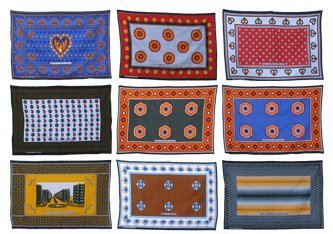
Swahili Kanga Sayings Today
A short while ago, I found myself on Uhuru Street, which arguably has the widest selection of kanga in Dar es Salaam.
Although I wasn’t really kanga shopping, I decided to look around and see what was new in the world of kangas.
After discovering some shocking jinas the last time I was kanga shopping, that’s what I decided to focus on this time.
The first thing I noticed was an unusual number of kangas with Islamic jinas, such as Mungu tuzidishie imani tufunge mwezi wa Ramadhani (translation: God, increase our faith so that we fast during the month of Ramadan).
I then remembered my brother telling me, the night before, that the next day would be the first day of Ramadan. (On that note, I wish a successful and spiritually-rich month of Ramadan to all my Muslim readers!).
Other jinas that caught my attention were:
- Mzoea nazi samli haiwezi (A person used to coconut oil cannot handle ghee)
- Sibora kitu bora utu (Being humane is better than material things)
- Ukijua kupokea ujue na kutoa (If you know how to receive, then know too how to give)
- Usiniwekee majungu bahati kanipa mungu (Don’t spread rumors about me, my luck is God-given.)
- Njama nimezisikia nangojea vitendo (I’ve heard the evil plans, now I await the actions)
- Msemaukweli ni mpenzi wa mungu (A person who tells the truth is God’s darling.)
- Niko kwangu yanini majungu (I’m in my own home, so why all the nasty rumors?)
- Tuliza roho yako mimi ni wako (Calm your spirit; I am yours)
- Mema na mabaya yapo lakini tusamehane (The good and the bad exist, but let’s forgive each other)
