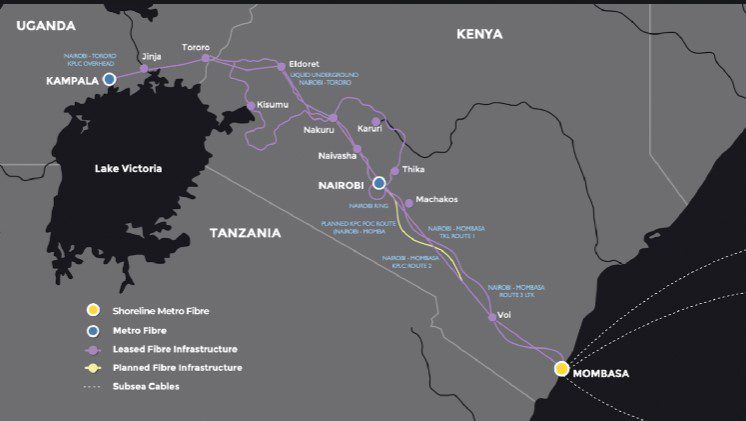
When people talk about the Seacom Kenya fibre network, they are talking about a much larger connectivity system than a typical fibre-to-the-home internet provider.
Seacom operates a combination of submarine cables, terrestrial fibre, network hubs and international connections, with Kenya serving as an important part of its East African network.
Seacom began operations in 2009, when its submarine cable connected countries along Africa’s eastern and southern coast to international networks. Today, the company says its infrastructure extends across more than 35,000 km of fibre in 17 African markets, supported by six subsea cable systems and 38 points of presence.
READ ALSO: SEACOM Fibre Packages / SEACOM Internet Packages
Table of Contents
How Seacom Kenya Fibre Network works
A useful way to understand Seacom in Kenya is to think of the network in three layers.
First is the submarine network. Seacom’s subsea infrastructure reaches Kenya through Mombasa, where international traffic can enter or leave the country.
Second is the terrestrial SEACOM Kenya fibre network.
Fibre carries traffic from Mombasa inland toward major population and business centres, including Nairobi.
Third are the network points of presence and connections to other networks.
These allow businesses, carriers and internet service providers to connect to Seacom’s backbone and reach destinations elsewhere in Africa and internationally.
Seacom’s current network information lists both Mombasa and Nairobi as network points of presence. Its live latency information, for example, shows a measured round-trip latency of about 6 ms between its Mombasa and Nairobi PoPs and about 12 ms between Nairobi and Dar es Salaam at the time of the published measurement.
SEACOM Kenya Fiber Network: Seacom’s Mombasa–Nairobi fibre route
One of the more significant recent developments is Seacom’s expansion of its terrestrial infrastructure between Mombasa and Nairobi.
In 2025, Seacom said it had activated new dark-fibre routes between Nairobi and Mombasa. The company described these as having two diverse paths, with solar-powered repeater stations in locations without access to grid electricity.
The purpose is to provide a higher-capacity terrestrial connection between the submarine cable landing infrastructure at the coast and Kenya’s main commercial and technology centre in Nairobi.
This matters because an international fibre connection is only as useful as the infrastructure carrying the traffic after it reaches land. A strong Mombasa landing station still needs a robust inland network to move traffic toward Nairobi and beyond.
Nairobi is particularly important
Nairobi is one of the major connectivity hubs in East Africa, so Seacom’s Kenyan network is not limited to simply bringing international bandwidth into the country.
In June 2026, Seacom launched a new high-capacity Nairobi–Kisumu–Kampala terrestrial route.
The route strengthens the connection between Kenya’s main technology and business centre and Uganda while providing another high-capacity path for traffic moving inland from Mombasa.
This gives the Kenyan portion of Seacom’s network a regional role. Traffic entering through Mombasa can move through Nairobi and onward toward Uganda and other parts of East Africa.
Is Seacom Fibre Available To Ordinary Home Users?
This is an important distinction.
Seacom’s Kenyan fibre network is primarily an enterprise, carrier and wholesale infrastructure network, rather than simply a retail home-internet network.
Seacom offers services such as:
- Dedicated Internet Access
- IP transit
- Carrier Ethernet
- Dark fibre
- Private lines
- MPLS
- VPN connectivity
- Colocation
- Cloud connectivity
- Managed networking
Its enterprise connectivity services are aimed particularly at organisations with multiple offices, business-critical applications or substantial connectivity requirements.
So when you see a Kenyan internet provider offering a fibre connection that ultimately uses Seacom infrastructure, the relationship may not be obvious to the end customer.
Seacom can provide the underlying backbone while another ISP provides the final connection into a home or business.
SEACOM Kenya Wholesale Capacity Lease Fiber Agreement
A SEACOM Kenya wholesale capacity lease fiber agreement would generally be a commercial telecommunications agreement under which one company obtains a defined amount of fibre-network capacity from SEACOM Kenya for a specified period, route, service level, and price.
The important point is that “capacity lease” does not necessarily mean leasing the physical fibre cable itself.
In Kenya’s wholesale telecom market, operators can build their own infrastructure, lease physical infrastructure, lease dark fibre, or simply purchase capacity on an existing network.
The Communications Authority of Kenya specifically distinguishes these different arrangements.
What a Seacom Wholesale Capacity Lease Actually Means
Imagine an internet service provider wants to serve customers in Nairobi but does not want to build its own long-distance fibre route to Mombasa.
Rather than constructing the entire route, it could obtain capacity from SEACOM.
The arrangement might effectively look like:
SEACOM network → defined fibre route → agreed capacity → customer’s network
The customer then uses that capacity to transport its own telecommunications traffic.
The customer could be:
- an ISP
- a mobile operator
- another telecommunications carrier
- a large enterprise
- a data-centre operator
- a cloud or technology company
- another wholesale connectivity provider
SEACOM is specifically identified by Kenya’s Communications Authority among the country’s carrier and wholesale service providers, alongside operators such as Liquid Telecom, Baobab, Airtel, Safaricom and Telkom.
Capacity Lease Versus Fibre Lease
This distinction is particularly important if you have come across the phrase “Wholesale Capacity Lease Fiber Agreement.”
There are several different things that a telecommunications company might acquire.
1. Physical infrastructure
A company could lease ducts, poles or other passive infrastructure and install its own fibre.
2. Dark Fibre
A company could lease an actual fibre strand that has been installed but is not being actively used.
It then supplies the optical equipment needed to transmit its own signals.
3. Lit Fibre
The fibre is already equipped and operating.
The customer purchases connectivity over it.
4. Capacity
Instead of taking control of a fibre strand, the customer purchases a specified amount of transmission capacity.
The Communications Authority describes these as different wholesale models.
It notes that a provider can build infrastructure, lease infrastructure and install its own fibre, lease dark fibre, or simply buy capacity, thereby avoiding the investment in physical infrastructure and equipment.
A capacity lease agreement therefore generally sits closer to the fourth model.
What Would Be Specified in the Agreement?
A real SEACOM wholesale capacity agreement would normally be considerably more detailed than simply saying that one company is leasing fibre.
Among the important commercial and technical terms would be:
Capacity
This specifies how much network capacity the customer is purchasing.
It could be expressed in units such as:
- Mbps
- Gbps
- wavelength capacity
- other carrier-grade capacity specifications
The capacity might be fixed or have provisions allowing it to be increased.
Route
The agreement would identify where the service operates.
For example, a route might connect:
Mombasa ↔ Nairobi
or potentially connect Nairobi with another location on SEACOM’s terrestrial network.
This is important because two connections with the same nominal bandwidth can have very different commercial value depending on their route, latency and redundancy.
Term
The agreement would specify how long the capacity is being leased.
Wholesale telecommunications contracts can be considerably longer than ordinary consumer internet contracts, particularly when substantial network capacity or long-term infrastructure commitments are involved.
There are examples elsewhere in the East African telecommunications market of operators entering long-term arrangements for undersea fibre capacity.
Vodacom Tanzania, for example, has disclosed long-term prepaid arrangements involving SEACOM and other fibre providers.
That does not mean every SEACOM Kenya capacity agreement has the same term. The specific contract controls.
Price
Wholesale capacity is normally priced according to factors such as:
- bandwidth
- route
- contract duration
- service type
- installation requirements
- redundancy
- service-level commitments
So there isn’t one standard public price for a “SEACOM fibre capacity lease.”
Historical pricing illustrates how dramatically wholesale economics can change.
When SEACOM launched in 2009, it announced wholesale prices substantially below the prevailing cost of satellite connectivity in the region.
Today’s commercial arrangements are negotiated according to the particular service and requirements.
Service Levels Are Important
A wholesale capacity agreement is not simply about bandwidth.
For a telecommunications operator, what happens when something goes wrong can be just as important.
A contract may therefore address matters such as:
- network availability
- latency
- packet loss
- fault response
- restoration time
- planned maintenance
- escalation procedures
- technical support
- redundancy
- service credits
This is one reason wholesale connectivity contracts are substantially different from ordinary home fibre subscriptions.
A home user might buy a package advertised as “100 Mbps.”
A carrier buying wholesale capacity needs to know which route that capacity takes, how it is handed over, what availability is promised and what happens if the route fails.
Why Redundancy Matters in a Seacom Agreement
SEACOM’s network in Kenya is part of a broader terrestrial and subsea network.
Its infrastructure includes international submarine connectivity as well as terrestrial routes.
SEACOM has also been expanding terrestrial capacity in Kenya, including new Nairobi-Mombasa infrastructure and the Nairobi-Kisumu-Kampala corridor.
That means a wholesale customer may be interested not merely in how much capacity it receives but also in how resilient the underlying route is.
For example, a customer might want:
Primary route + geographically diverse backup route
rather than putting all of its traffic through one physical path.
This can make the commercial agreement considerably more valuable than a simple “X Gbps fibre connection.”
Does the Customer Own the Fibre?
Usually, no.
This is probably the biggest misconception to avoid when reading the phrase “fibre lease.”
If a company signs a wholesale capacity agreement with SEACOM, that does not ordinarily mean that the company has purchased the underlying SEACOM cable.
The customer is obtaining a right to use specified network capacity under the contractual terms.
The distinction can be illustrated like this:
Owning fibre
You own the physical asset.
Leasing dark fibre
You have contractual use of a physical fibre strand and generally provide the active equipment.
Leasing lit capacity
The network operator operates the fibre and equipment, while you purchase connectivity over the network.
Those arrangements have very different technical and accounting implications.
What Might the Customer Use the Capacity For?
Suppose a Kenyan ISP purchases 10 Gbps of wholesale capacity from SEACOM.
The ISP could use that capacity as part of the infrastructure supporting its own customers.
The chain could look something like:
SEACOM international/subsea infrastructure
↓
SEACOM Kenyan terrestrial network
↓
Wholesale capacity handoff
↓
ISP’s network
↓
ISP’s customers
The customer therefore doesn’t necessarily see “SEACOM” when using the internet.
The ISP may sell the end user a completely different product under its own brand.
What Broadband Speeds to Seacom Offer in South Africa Pricing
If you’re asking specifically about SEACOM’s broadband/fibre internet offerings in South Africa and their pricing, there is an important distinction: SEACOM South Africa primarily markets fibre connectivity to businesses and enterprises, rather than as a mass-market residential ISP.
SEACOM fibre speeds in South Africa
SEACOM has offered business fibre at a range of speeds, with its older Business Internet Essentials packages ranging from 5 Mbps to 300 Mbps, while larger-business packages went from 10 Mbps up to 1 Gbps.
Its more recent enterprise offerings are considerably faster:
- Up to 10 Gbps for its enterprise pre-fibred-building service
- 10 Gbps to 100 Gbps for Direct Internet Access on a single interface
- Symmetrical connectivity, meaning upload and download capacity can be the same
- Uncapped and unshaped service on the relevant enterprise products
SEACOM’s current network information also lists 10–100 Gbps IP capacity as part of its broader network capabilities.
What About the Price?
SEACOM does not appear to publish one current nationwide retail price list for its business fibre. Pricing depends on the product, building, location, bandwidth, contract term and other requirements.
However, there are publicly listed prices from a South African SEACOM reseller that give an indication of the pricing structure. The listed Broadband Fibre prices are:
| Speed | Monthly price, ex VAT |
|---|---|
| 10 Mbps | R1,249 |
| 50 Mbps | R2,899 |
| 100 Mbps | R3,799 |
| 500 Mbps | R9,499 |
| 1 Gbps | R11,999 |
These particular prices are advertised for SEACOM connected buildings, with a 12-month term.
The reseller describes this tier as broadband rather than dedicated fibre, and notes that 1:1 contention and symmetrical bandwidth are not guaranteed.
There are also higher-priced Dedicated Fibre packages from the same reseller:
| Speed | Monthly price, ex VAT |
|---|---|
| 10 Mbps | R2,365 |
| 50 Mbps | R5,865 |
| 100 Mbps | R7,965 |
| 500 Mbps | R14,765 |
| 1 Gbps | R17,065 |
Those packages are advertised with 1:1 contention, symmetrical bandwidth and a 99% SLA, with 12- or 24-month contracts.
A cheaper Broadband Fibre Lite tier is also listed, from R845/month for 10 Mbps through R10,799/month for 1 Gbps, ex VAT. This tier has a best-effort SLA and does not guarantee 1:1 contention or symmetrical bandwidth.
Photo Credits: linx.net; TechWeez
Believe you me, the Internet is revolutionised in Nairobi. There was a time you would sit down to download things for hours and hours nut last night I was trying to purchase stuff online and my word, the difference was phenomenal. Even my Mum remarked on the speeds!! And she knows nothing about Internet.
I haven’t watched news for a long time either, I think there’s nothing more depressing than hearing the wrong kinds of things about your country day in and day out. I just can’t take it anymore, like you I know somebody’s gonna blog about it.
Lol, Mama. The life of a blogger! I see I am not the only one who depends on blogs to see what is going on. 🙂
I have been wondering about this cable that has failed to worm it’s way into UG… i must say like you am looking for a faster inexpensive way to surf and be on the net (prefferably at no cost yeah u know me!!!) So i can’t say i have felt the effect. I noticed u said the countries along the sealine. what does that mean for we the landlocked? as usual tho UG is on about how expensive it is to lay the fibreoptic and how the costs myust be inflated… trully this is all still a mystrery… i only know that different groups of people dig up the roads and such like all over Kampala.. could this be it? so u can tell i know nothing and have been barely affected!
Jurie, from what I hear, the cable has already wormed its way to UG. I’ve read on many Ugandan blogs over the past couple of months about how much faster Internet is in Kampala. Who is your current service provider? (If you want to know more, I suggest you talk to our techie Uncle. You know how he knows everything about such things! :-))
I use BOL in dar es salaam, and the fibre optic has made very little difference to my speed. It is still too slow to use skype and other good applications.
In fact, I’ve been looking for a new internet provider, and was wondering if you could tell me just how fast the TTCL unlimited service you get is?
Hi BongoBoi,
Welcome to ChickAboutTown! I apologize for how long it’s taken me to respond to your comment.I cannot quantify the current speed of my TTCL unlimited broadband, but allow me to say that it’s frustratingly slow, especially if I am not multi-tab browsing. (If I am multitab browsing, t’s fine for the most part). I don’t Skype, but to use the common example of YouTube videos, I have to wait for a video to load fully before I attempt to watch it, because otherwise it plays too slow to make sense. If you are interested in an extremely fast connection, how about trying one of TTCL’s limited packages?
I look forward to hearing what you settle on if you finally decide to change providers.
Biche