READ ALSO: Half of a Yellow Sun Summary: Chapters 21 & 22
Table of Contents
Kenyan Indigenous Games #1: Wrestling (Enyameni, Ndikano)
A number of communities in Kenya practice traditional wrestling, including the Abagusii where it is known as enyameni and the Ameru where it is called ndikano.
Generally, these games feature two strong men, each preferably married, aged between 25 and 45 years.
These men battle it out in an open field with a charged crowd cheering them on.
Winning the game requires a combination of both strength and strategy. He who fells his opponent is declared the winner.
These traditional forms of wrestling risk losing their significance as people shift their interest towards foreign forms of wrestling.
Kenya Indigenous Games #2: Stick Fights
You will find some sort of stick fighting among several different communities in Kenya, especially herding ones.

The sport is also very popular in Lamu on the Kenyan coast.
If you visit Lamu, you will often find crowds enjoying a stick fight at the waterfront.
This form of stick fighting is believed to have originated from Oman, which has historical ties with Lamu that stretch back more than a century.
Kenyan indigenous games are traditional forms of play and sport that developed within the country’s different communities and were passed down through generations. They include board games, physical contests, running and chasing games, throwing activities, wrestling, jumping games, memory games, and games involving singing, imitation or storytelling. Because Kenya is home to many different cultural communities, there is no single list of games that represents the entire country. The games associated with the Luo, Kikuyu, Kamba, Meru, Embu, Maasai, Luhya, Swahili and other communities can differ considerably.
These games traditionally served purposes beyond entertainment. Running, swimming, throwing and wrestling, for example, could develop abilities connected with hunting, fishing, defence and everyday life. Other games encouraged memory, calculation, observation, strategic thinking and cooperation. Games were also ways for older members of a community to pass knowledge and social values to younger people.
Indigenous Games in Kenya 3 & 4: Bao and Ajua
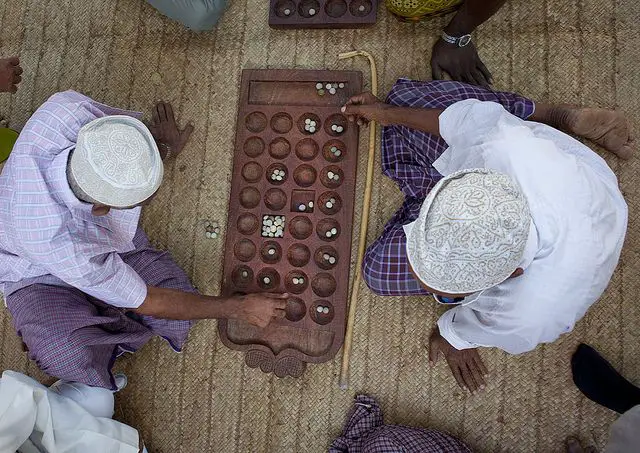
One of the best-known Kenyan indigenous games is Bao, a traditional mancala-type board game particularly associated with the Swahili coast. Different Kenyan communities have their own names and forms of related games. Among the Luo, for example, the game is known as Ajua, while related versions have been known as Giuthi among the Kikuyu and Ntotoi among the Samburu.
Bao involves moving seeds, stones or other counters around pits in a board. Players have to anticipate their opponent’s moves and make strategic decisions about where to distribute and capture counters. Consequently, the game involves considerably more mental calculation than its simple equipment might suggest.
Ajua has also had an important social dimension among the Luo. Recent scholarship describes it as a setting in which questions of age, gender and social identity could be expressed and negotiated. This illustrates how an indigenous game can tell us something about the society in which it developed, rather than being merely a pastime.
Type of Indegnous Kenyan Games: Kati and Other Children’s Games
Kenyan indigenous games also include many active children’s games. Kati, for example, is a traditional catching and throwing game involving two groups of players. Depending on the particular rules being used, some players remain inside a designated area while others attempt to hit them with a soft ball. Such games require agility, speed, dodging ability and teamwork.
Other games involve hopping, jumping or negotiating spaces marked on the ground. Ten-ten, for example, is a Kenyan form of hopscotch in which players hop through marked spaces while manipulating a small object.
These games require balance, coordination and concentration while also providing opportunities for children to play together.
Indigenous Kenyan Games: Types of Indigenous Kenyan Animal Games
If you would like to know more about types of indigenous Kenyan animal games, click here.
Difference Between Ajua and Bao in Indigenous Kenyan Games
Ajua and Bao are traditional African board games that belong to the mancala family of games, in which players move seeds or other counters around pits in a board, attempting to capture their opponent’s counters.
Both games are associated with Kenya’s indigenous sporting and cultural heritage, but they differ in their traditional communities, board designs, rules and level of complexity.
The most important distinction is that Ajua is associated particularly with the Luo community of western Kenya, while Bao la Kiswahili is associated with Swahili communities along the Kenyan coast.
Although the games share a common family of gameplay, they are not necessarily identical versions of the same game.
1. Main differences between Ajua and Bao
Ajua
- Traditionally associated with the Luo community.
- Commonly described in Kenyan educational materials as a board with two rows of eight playing pits, sometimes with a larger storage pit at each end.
- Uses seeds or small stones as counters.
- Emphasises sowing counters, capturing them and planning moves to gain an advantage.
Bao la Kiswahili
- Traditionally associated with Swahili communities, particularly along the East African coast.
- The traditional board has four rows of eight pits, making 32 pits in total.
- Uses seeds or similar counters, with special pits known as nyumba (houses).
- Has more elaborate sowing and capture rules in its established form, demanding considerable strategic planning.
These descriptions refer to commonly documented forms of the games.
Traditional rules can differ by region, and simpler versions are also played.
2. Differences in the playing boards
The board is one of the easiest ways to distinguish the two games.
Ajua: The version commonly taught in Kenyan school materials uses two rows of eight pits. Each player controls one row. Some versions include a larger storage pit at each end for collecting captured counters.
Bao: The established Bao la Kiswahili board has four rows of eight pits.
Each player controls two rows, one inner row and one outer row.
Certain pits have special significance, particularly the nyumba, which affects how the game is played.
The additional rows and special rules make Bao la Kiswahili more complicated to learn and play than many simplified mancala games.
3. Differences in the Rules
Both games involve two players distributing counters from one pit to another.
This process is called sowing. Players attempt to capture their opponent’s counters while protecting their own position.
However, the exact rules depend on the version being played.
| Feature | Ajua | Bao la Kiswahili |
|---|---|---|
| Number of pits | Commonly 16 playing pits, arranged in two rows of eight | 32 pits, arranged in four rows of eight |
| Player’s territory | Usually one row | Two rows |
| Main actions | Sowing and capturing counters | Sowing, capturing and managing special pits |
| Winning objective | Often to capture more counters or leave the opponent unable to move | In the established version, to empty the opponent’s inner row or leave them unable to make a legal move |
| Complexity | Generally simpler in the commonly taught version | More elaborate rules and strategic possibilities |
It is worth noting that not every version of Ajua uses precisely the same winning conditions. Similarly, Bao has several regional rule sets. It is therefore better to identify the particular version being played than to assume that every community follows identical rules.
4. Cultural Differences
Ajua is particularly significant in Luo cultural history. It has been played as a social activity and a competitive game, with its playing spaces and conventions reflecting aspects of community life.
Although it has sometimes been described as a game primarily for men, historical and ethnographic research indicates that participation was not always limited to that group.
Bao la Kiswahili has a long-standing association with the Swahili coast. Traditionally, people played it on carved wooden boards or on improvised boards made by hollowing pits into wood or digging them into the ground.
Its established rules support extended contests involving careful calculation, tactical captures and anticipation of an opponent’s moves.
Both games help preserve cultural knowledge and provide opportunities for social interaction.
They also develop mathematical thinking, concentration, planning and problem-solving skills.
5. Similarities between Ajua and Bao
Despite their differences, Ajua and Bao share several characteristics.
- Both are traditional African board games in the mancala family.
- Both are generally played by two opponents.
- Both use seeds, stones or similar counters.
- Both require players to distribute counters between pits.
- Both involve capturing an opponent’s counters.
- Both depend on calculation, concentration, memory and strategic thinking.
- Both have cultural significance beyond recreation.
Conclusion
The main difference between Ajua and Bao in indigenous Kenyan games is their traditional cultural association, board structure and rules. Ajua is particularly associated with the Luo and is commonly represented by a two-row board with eight pits per row. Bao la Kiswahili is associated with Swahili communities on the coast and uses a four-row board with 32 pits, including special pits that influence play.
Both games demonstrate the importance of traditional African games as forms of recreation, intellectual development and cultural expression. Although they belong to the same broad family, their distinctive boards and rules give each game its own identity.
Amakhu Kenyan Traditional Game
Amakhu is a traditional activity associated with the Abanyala community of Kakamega County in western Kenya. Unlike board games such as Ajua and Bao, which involve moving counters according to set rules, Amakhu is described as a game involving fights between bulls.
It took place in grazing fields, where herders and spectators watched the animals challenge one another.
The game is part of the traditional sporting and recreational practices documented among the Abanyala of Kakamega.
It illustrates how indigenous games could emerge from activities connected with livestock keeping and everyday community life.
1. What Is Amakhu?
Amakhu involved confrontations between cattle, specifically bulls. According to descriptions of traditional Abanyala games, these encounters could occur spontaneously while cattle were grazing. People nearby watched, cheered and jeered as the bulls fought.
In some cases, herders deliberately brought bulls from different herds together to provoke a confrontation.
The activity was therefore not necessarily organised as a formal sporting event with a fixed date, a designated playing field or a written set of rules.
Amakhu was associated particularly with the Abanyala of Kakamega, so it should not be treated as a game practised in precisely the same way throughout Kenya.
2. How Was Amakhu Played?
Descriptions of the game identify several characteristic features.
1. Bulls were the main participants. The central activity involved confrontations between bulls, sometimes belonging to different herds.
2. The grazing field served as the playing area. The encounters took place in the ordinary spaces where cattle grazed rather than in a specially constructed sports facility.
3. Spectators gathered to watch. Herders and other people present could cheer or jeer as the animals confronted one another.
4. Some encounters were deliberately provoked. Herders could encourage bulls from separate herds to fight, rather than simply waiting for a spontaneous confrontation.
5. There was no fixed competition schedule. Amakhu was described as an informal activity rather than a regularly scheduled tournament with standardised rounds and a formal championship.
These features distinguish Amakhu from organised wrestling or modern competitive sports, which generally have defined participants, rules and procedures for determining a winner.
3. Children’s Version of Amakhu
Amakhu was also associated with children’s play. Children made animal toys out of soil and used them to imitate fights between animals. This imitation was also called Amakhu.
The children’s version is an interesting example of how young people reproduced activities they observed in their surroundings through imaginative play. Rather than needing manufactured toys, they could use soil to create animal figures and recreate scenes involving cattle.
Such play could encourage creativity, observation and social interaction.
It also illustrates how children adapted familiar aspects of community life into their own games.
4. Cultural Significance of Amakhu
Amakhu provides an example of the relationship between indigenous games and the environments in which communities lived.
For communities where livestock keeping was important, cattle were part of everyday economic and social life. Activities involving cattle could consequently become occasions for observation, excitement and communal interaction.
The game also demonstrates that traditional games did not always resemble modern sports. Some involved clearly defined competitions, while others emerged informally from daily activities. Children’s imitation of bull fights provided another form of play connected with the same cultural setting.
However, Amakhu should be understood as a historically documented cultural practice rather than assumed to be a universal tradition among all Kenyan communities.
5. Is Amakhu Still Played Today?
There is limited readily available documentation establishing how frequently Amakhu is practised today or whether its traditional forms continue in particular Abanyala communities. Its inclusion in accounts of indigenous games helps preserve knowledge of the practice, but it does not establish its current prevalence.
It is also important to distinguish historical cultural description from present-day animal welfare standards. Deliberately provoking bulls to fight can cause serious injuries to animals and people. The historical account of Amakhu should not be taken as a recommendation to recreate such confrontations.
Conclusion
Amakhu is a traditional activity documented among the Abanyala of Kakamega in western Kenya. Its characteristic form involved bulls fighting in grazing fields, with people watching and reacting to the encounters. Children also played a version in which they made animal figures from soil and imitated animal fights.
Amakhu is distinctive because it connects traditional recreation with livestock keeping and children’s imaginative play. It also demonstrates the cultural variety of Kenyan indigenous games, which range from strategic board games to physical contests and informal activities rooted in everyday life.