Indigenous board games are traditional games developed and played by the native communities of different parts of the world. They reflect the histories, customs, intellectual traditions and social lives of the people who created them.
Long before commercially manufactured board games became popular, communities used carved wooden boards, holes in the ground, stones, seeds, shells, sticks and other readily available materials to create games. These games provided entertainment while encouraging strategic thinking, mathematical ability, memory, patience and friendly competition.
Indigenous board games are particularly interesting because they demonstrate how different societies developed their own approaches to strategy, chance, counting and problem-solving.
Africa has an especially rich tradition of indigenous board games. Some, such as Bao, have been played across generations and remain part of everyday cultural life in certain communities.
Table of Contents
1. What Are Indigenous Board Games?
Indigenous board games are games that originated within particular indigenous societies or cultural communities and were traditionally passed from one generation to another.
They generally have several characteristics:
- Cultural origins: They developed within particular communities and reflect local traditions.
- Traditional materials: Many were originally made using wood, stones, seeds, shells, clay or materials found in nature.
- Oral transmission: Their rules were often taught through observation and practical experience rather than written instructions.
- Strategic thinking: Many require players to plan moves, anticipate opponents’ actions and make decisions.
- Social interaction: They traditionally bring together family members, friends and members of the wider community.
Some indigenous board games have existed for centuries, while others have histories that are more difficult to establish because their original equipment was made from perishable materials.
Examples of Indigenous Board Games
Here are some notable examples from Africa and other parts of the world.
Example of Indigenous Games #1. Bao (East Africa)
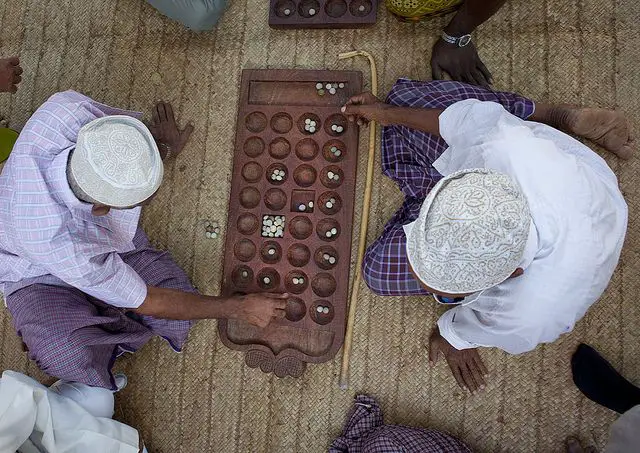
Bao is one of East Africa’s best-known traditional board games. It is particularly associated with Swahili culture and is played in Tanzania, Zanzibar, Kenya and other parts of the region.
The game belongs to the larger family of games known as mancala, which involve moving seeds or counters between holes arranged in rows.
A traditional Bao board has:
- Four rows of eight holes, making 32 holes in total.
- Playing pieces traditionally consisting of seeds, shells or small stones.
- Two players, each controlling two rows of the board.
Players move their seeds around the board according to established rules, attempting to capture their opponent’s pieces and eventually win the game.
Bao is particularly interesting because it requires considerable concentration, forward planning and the ability to anticipate several possible moves.
It also has an important place in Swahili cultural heritage. The game is associated with social gatherings and friendly competition, and skilled players can attract an audience.
Different Types of Indigenous Games #2. Oware (West Africa)
Oware is a traditional strategy game associated particularly with the Akan people of Ghana.
It is also played in other parts of West Africa and has variations across the region.
The traditional Oware board contains two rows of six holes. Each player controls one row, and the playing pieces are usually seeds or small stones.
The objective is to capture more seeds than the opponent.
Players distribute seeds among the holes in a process commonly called sowing.
Depending on where the final seed lands, a player may capture seeds from the opponent’s side.
Oware is a mathematical and strategic game that requires players to calculate their moves carefully.
The game is also known as a form of social entertainment and is traditionally played by adults and children.
3. Omweso (Uganda)
Omweso is a traditional Ugandan board game belonging to the mancala family.
It is played on a board containing four rows of eight holes, similar in general layout to the traditional Bao board.
Players use seeds or small counters and move them around the board according to a complex set of rules.
Omweso is particularly associated with the Baganda people of Uganda and has historically been played in social and royal settings.
The game requires players to think several moves ahead.
Its complexity makes it an excellent example of the sophisticated strategic games developed within African societies.
4. Isolo (Tanzania)
Isolo is another traditional East African mancala game associated with Tanzania.
Like Bao and Omweso, it involves moving seeds between holes arranged on a board.
The particular rules and board arrangements can vary according to the local tradition.
Isolo demonstrates the variety of traditional counting and strategy games found in East Africa.
Although these games share certain characteristics, they should not all be treated as identical games.
Their rules, terminology and cultural associations can differ considerably.
5. Senet (Ancient Egypt)
Senet was an ancient Egyptian board game that dates back thousands of years.
Its board consists of 30 squares arranged in three rows of ten. Players move their pieces along a winding route across the board.
The game was played in ancient Egyptian society and appears in archaeological discoveries, tomb paintings and other historical material.
Senet eventually acquired religious associations, particularly with the journey of the deceased into the afterlife.
Although its precise original rules are not completely known, it remains one of the most recognisable board games from ancient Egypt.
6. Patolli (Mesoamerica)
Patolli was a traditional board game played by several Mesoamerican peoples, including the Aztecs.
It was played on a cross-shaped board, with players moving their pieces according to the results of throwing beans or other marked objects.
The game involved counting, strategy and chance.
Patolli was more than a recreational activity.
It had cultural and religious associations, and wagering could form part of the game.
7. Go (China)
Go, known as Weiqi in Chinese, is an ancient strategy board game originating in China.
It is played on a grid, traditionally measuring 19 by 19 lines, using black and white stones.
Players take turns placing their stones on the intersections of the grid.
The objective is to surround and control more territory than the opponent.
Go is particularly notable for its strategic depth.
Although its basic rules are relatively straightforward, the number of possible moves makes it an exceptionally complex game.
8. Pachisi (India)
Pachisi is a traditional Indian board game that has been played for centuries.
It is commonly played on a cross-shaped board, with players moving their pieces around the board according to the results of throwing cowrie shells or other traditional counting devices.
The objective is to move all one’s pieces around the board and reach the home position before the other players.
Pachisi is an important historical example of a traditional Indian game.
It is also associated with the development of later games, including Ludo.
9. Hounds and Jackals (Ancient Egypt)
Hounds and Jackals, also known as the Game of Fifty-Eight Holes, was an ancient Egyptian and Near Eastern board game.
The board contains 58 holes into which players inserted playing pieces shaped like animal heads.
The game involved moving pieces along a designated route, with the objective of reaching the end before the opponent.
Archaeological discoveries show that it was played in ancient Egypt and neighbouring regions.
10. Sungka (Philippines)
Sungka is a traditional Filipino board game belonging to the mancala family.
It is played using a wooden board with two rows of seven small holes and larger storage holes at either end.
Players distribute shells, seeds or stones among the holes, attempting to collect as many pieces as possible in their storage areas.
Sungka is traditionally played by two people and is particularly associated with family and community recreation in the Philippines.
11. Puluc (Guatemala)
Puluc, also called Bul, is a traditional race-and-capture game associated with the Maya people of Guatemala.
It is played using a linear arrangement of spaces, with players moving their pieces along the playing area.
The game involves capturing opposing pieces and attempting to advance one’s own pieces towards victory.
Puluc provides an example of the different types of board games developed in indigenous communities of Central America.
12. Yut Nori (Korea)
Yut Nori is a traditional Korean board game that has been played for generations.
Players use four specially marked wooden sticks instead of conventional dice to determine how far their pieces move around a cross-shaped playing route.
The game is commonly played in teams and is particularly associated with Korean celebrations, including Lunar New Year.
It combines chance, planning and cooperation.
4. Classification of Indigenous Board Games
Indigenous board games can be classified according to their playing methods and objectives.
| Type of game | Main objective | Examples |
|---|---|---|
| Sowing games | Distribute and capture seeds or counters | Bao, Oware, Omweso |
| Strategy games | Outsmart the opponent through careful planning | Go, Omweso |
| Race games | Move pieces around a board to reach a destination | Senet, Pachisi |
| Capture games | Capture or eliminate opposing pieces | Puluc |
| Chance-based games | Use dice, sticks or other randomising objects | Yut Nori, Patolli |
Some games belong to more than one category.
For example, Senet combines elements of racing and chance.
5. Materials Used in Indigenous Board Games
One interesting aspect of traditional board games is the creativity involved in making their equipment.
Many communities developed games using materials that were readily available in their surroundings.
Common materials include:
- Wood: Used to carve boards, holes and playing pieces.
- Seeds: Frequently used as counters in African mancala games.
- Stones and pebbles: Used as inexpensive playing pieces.
- Shells: Used as counters or in some games to determine moves.
- Clay: Used to make playing pieces and sometimes boards.
- Earth and sand: Used to create temporary playing boards by making holes in the ground.
Some games did not require a manufactured board at all. Players could simply create a playing area in the ground.
6. Importance of Indigenous Board Games
Indigenous board games have cultural, educational and social importance.
1. Preservation of cultural heritage
Traditional games preserve knowledge, customs and recreational practices that have been passed down through generations. They provide a connection to the history of particular communities.
2. Development of mathematical skills
Games such as Bao and Oware involve counting, addition, distribution and predicting numerical outcomes. Players develop mathematical thinking through practical experience.
3. Improvement of strategic thinking
Many traditional games require players to anticipate their opponents’ moves and plan several steps ahead.
4. Social interaction
Board games provide opportunities for people to spend time together. They encourage conversation, competition, cooperation and the sharing of knowledge between generations.
5. Intergenerational Learning
Older players often teach younger family and community members how to play.
This helps preserve traditional rules and cultural knowledge.
6. Creativity and resourcefulness
Many indigenous games demonstrate how communities created sophisticated entertainment using simple, locally available materials.
7. Historical Understanding
Traditional games offer insights into the intellectual and social lives of earlier societies.
They can also help researchers study cultural exchange, migration and historical contact between communities.
7. Indigenous Board Games in Tanzania and East Africa
For a Tanzanian and East African perspective, Bao deserves particular attention.
Bao la Kiswahili is strongly associated with the Swahili cultural world, including coastal Tanzania and Zanzibar. It is played using a carved wooden board and small playing pieces.
Its traditional board has four rows of eight holes. The game is played by two opponents, each controlling two rows.
Bao is particularly demanding because players must understand the movement of seeds, opportunities for capturing their opponents’ pieces and the consequences of their decisions.
Other important East African examples include:
- Omweso: Associated with Uganda, particularly Buganda.
- Isolo: A traditional game associated with Tanzania.
- Bao la Kiarabu: A related mancala game with different rules from Bao la Kiswahili.
These games illustrate the richness of East African recreational traditions. They also demonstrate that African societies developed complex games of logic and strategy long before modern commercial board games became widespread.
8. Indigenous Board Games Versus Modern Board Games
Indigenous and modern board games share many characteristics, but there are differences in their historical development, materials and cultural associations.
| Indigenous board games | Modern commercial board games |
|---|---|
| Often originate within particular cultural communities | Often developed by individual designers or companies |
| Traditionally passed down through generations | Usually distributed through commercial channels |
| Frequently use locally available materials | Often use manufactured plastic, cardboard and other materials |
| May have regional variations in their rules | Generally have published standardised rules |
| Often have strong cultural and social associations | May be designed primarily for entertainment or competition |
However, the two categories are not mutually exclusive. Traditional games can be manufactured commercially, and modern games can incorporate ideas from older indigenous games.
9. Preserving Indigenous Board Games
Many traditional games face the possibility of declining participation as entertainment habits change.
Younger generations may become more familiar with digital games and internationally marketed board games than with the traditional games of their own communities.
Preservation can take several forms:
- Teaching traditional games in schools.
- Organising community competitions and cultural festivals.
- Recording traditional rules and regional variations.
- Producing locally made boards and playing pieces.
- Documenting the histories and terminology associated with each game.
- Creating digital versions that introduce traditional games to younger audiences.
- Encouraging older and younger generations to play together.
In Tanzania, for example, promoting Bao in schools and cultural institutions would help maintain knowledge of an important part of Swahili heritage.
Conclusion
Indigenous board games are an important part of the cultural and intellectual heritage of societies around the world. From Bao in East Africa and Oware in West Africa to Senet in ancient Egypt, Patolli in Mesoamerica and Go in China, these games demonstrate the many ways communities developed entertainment based on strategy, mathematics, chance and competition.
They also challenge the assumption that sophisticated strategic games are exclusively a modern invention. Traditional societies developed intricate games using simple materials and passed their knowledge from one generation to another.
Preserving indigenous board games is therefore about more than keeping old forms of entertainment alive.
It is also about protecting cultural knowledge, celebrating intellectual traditions and ensuring that future generations remain familiar with the games their communities developed.
READ ALSO: Half of a Yellow Sun Summary: Chapters 21 & 22
Kenyan Indigenous Games #1: Wrestling (Enyameni, Ndikano)
A number of communities in Kenya practice traditional wrestling, including the Abagusii where it is known as enyameni and the Ameru where it is called ndikano.
Generally, these games feature two strong men, each preferably married, aged between 25 and 45 years.
These men battle it out in an open field with a charged crowd cheering them on.
Winning the game requires a combination of both strength and strategy. He who fells his opponent is declared the winner.
These traditional forms of wrestling risk losing their significance as people shift their interest towards foreign forms of wrestling.
Kenya Indigenous Games #2: Stick Fights
You will find some sort of stick fighting among several different communities in Kenya, especially herding ones.

The sport is also very popular in Lamu on the Kenyan coast.
If you visit Lamu, you will often find crowds enjoying a stick fight at the waterfront.
This form of stick fighting is believed to have originated from Oman, which has historical ties with Lamu that stretch back more than a century.
Kenyan indigenous games are traditional forms of play and sport that developed within the country’s different communities and were passed down through generations. They include board games, physical contests, running and chasing games, throwing activities, wrestling, jumping games, memory games, and games involving singing, imitation or storytelling. Because Kenya is home to many different cultural communities, there is no single list of games that represents the entire country. The games associated with the Luo, Kikuyu, Kamba, Meru, Embu, Maasai, Luhya, Swahili and other communities can differ considerably.
These games traditionally served purposes beyond entertainment. Running, swimming, throwing and wrestling, for example, could develop abilities connected with hunting, fishing, defence and everyday life. Other games encouraged memory, calculation, observation, strategic thinking and cooperation. Games were also ways for older members of a community to pass knowledge and social values to younger people.
Indigenous Games in Kenya 3 & 4: Bao and Ajua
One of the best-known Kenyan indigenous games is Bao, a traditional mancala-type board game particularly associated with the Swahili coast. Different Kenyan communities have their own names and forms of related games. Among the Luo, for example, the game is known as Ajua, while related versions have been known as Giuthi among the Kikuyu and Ntotoi among the Samburu.
Bao involves moving seeds, stones or other counters around pits in a board. Players have to anticipate their opponent’s moves and make strategic decisions about where to distribute and capture counters. Consequently, the game involves considerably more mental calculation than its simple equipment might suggest.
Ajua has also had an important social dimension among the Luo. Recent scholarship describes it as a setting in which questions of age, gender and social identity could be expressed and negotiated. This illustrates how an indigenous game can tell us something about the society in which it developed, rather than being merely a pastime.
Type of Indegnous Kenyan Games: Kati and Other Children’s Games
Kenyan indigenous games also include many active children’s games. Kati, for example, is a traditional catching and throwing game involving two groups of players. Depending on the particular rules being used, some players remain inside a designated area while others attempt to hit them with a soft ball. Such games require agility, speed, dodging ability and teamwork.
Other games involve hopping, jumping or negotiating spaces marked on the ground. Ten-ten, for example, is a Kenyan form of hopscotch in which players hop through marked spaces while manipulating a small object.
These games require balance, coordination and concentration while also providing opportunities for children to play together.
Indigenous Kenyan Games: Types of Indigenous Kenyan Animal Games
If you would like to know more about types of indigenous Kenyan animal games, click here.