Searching for information about heat protectant site:chickabouttown.com?
Whether you love wearing sleek silk presses, bouncy blowouts, beautifully defined curls or straightened natural hair, heat styling offers plenty of possibilities for changing your look.
However, frequent use of blow dryers, flat irons, curling irons and hot combs can take a toll on your hair, leaving it dry, brittle and prone to breakage.
This is where a heat protectant comes in.
Designed to minimise damage caused by heated styling tools, heat protectants help shield individual strands from excessive heat exposure while maintaining a smoother, healthier-looking finish.
But what exactly does a heat protectant do, how should you use one, and which formulas are worth considering?
Let’s take a closer look.
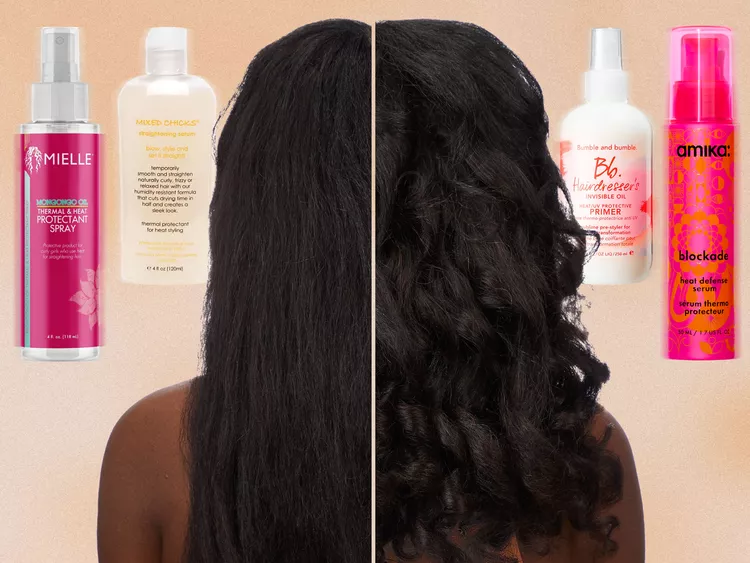
Table of Contents
1. What Is a Heat Protectant Site:ChickAboutTown.com?
A heat protectant is a leave-in hair treatment applied before using heated styling equipment.
It is formulated to create a thin protective film around the hair shaft.
This coating helps reduce the direct impact of heat on the hair fibres.
Depending on its formulation, a heat protectant may also:
- Reduce moisture loss during heat styling.
- Smooth the hair cuticle.
- Minimise frizz.
- Improve shine.
- Make hair easier to comb and style.
- Reduce friction between individual strands.
- Help hair retain a smoother appearance after straightening or curling.
Heat protectants are available in different formulations, including sprays, creams, lotions, serums and certain leave-in conditioners.
2. How Does Heat Protectant Site:Chickabouttown.com Work?
To understand how heat protectant works, it helps to understand what happens when hair is exposed to high temperatures.
Hair consists primarily of keratin, a structural protein. Its outer layer, known as the cuticle, consists of overlapping protective cells.
Repeated exposure to high heat can damage this outer layer and affect the protein structure inside the hair shaft.
The consequences may include:
- Rough, raised cuticles.
- Increased dryness.
- Loss of elasticity.
- Brittle strands.
- Split ends.
- Increased breakage.
Heat protectants contain ingredients that form a coating around the hair fibres.
Certain silicones, conditioning polymers and hydrolysed proteins can help slow heat transfer and distribute heat more evenly.
This reduces some of the stress associated with heat styling.
However, even a good heat protectant cannot completely prevent thermal damage.
Avoiding unnecessary heat exposure remains important.
3. Different Types of Heat Protectants
Heat protectants come in several forms.
The best choice depends on your hair texture, thickness, condition and preferred styling method.
Heat Protectant Sprays
Sprays are among the most popular options.
They distribute easily through the hair and are particularly convenient when preparing hair for blow-drying, flat ironing or curling.
Lightweight sprays are often suitable for fine and medium-density hair.
Heat Protectant Creams
Creams generally have a richer consistency than sprays.
They can provide additional conditioning and help with manageability.
They are worth considering for thick, coarse, dry or naturally curly hair.

Heat Protectant Serums
Serums are often formulated with smoothing and conditioning ingredients.
Depending on the formulation, they can help reduce frizz, improve shine and make hair easier to manage.
Check that a serum specifically provides heat protection rather than assuming all hair serums do.
Heat-Protective Leave-In Conditioners
Some leave-in conditioners combine moisturising, detangling and heat-protective properties.
They can be particularly useful for curly, coily and chemically treated hair.
Look for an explicit heat-protection claim on the packaging.
4. How to Use Heat Protectant Correctly
Applying heat protectant properly is important because the product needs to reach the hair strands that will be exposed to heat.
1990s-Inspired Blowout site:chickabouttown.com
A 1990s-inspired blowout is a voluminous hairstyle characterised by full-bodied hair, soft curls, rounded ends and plenty of movement.
Inspired by the supermodel hairstyles and glamorous celebrity looks of the 1990s, this blow-dry technique creates hair that looks polished, healthy, glossy and beautifully full.
The hairstyle is enjoying renewed popularity, particularly among people looking for alternatives to flat, poker-straight hairstyles and tightly defined curls.
Its appeal lies in its combination of volume, softness and movement.
For anyone who remembers the hair fashions of the 1990s, the look brings back memories of supermodels such as Cindy Crawford, Claudia Schiffer and Naomi Campbell, whose voluminous hairstyles helped define the decade’s beauty trends.
What Does a 1990s-Inspired Blowout Look Like?
The traditional 1990s blowout is recognisable by several features:
- Big, voluminous roots: Hair has noticeable lift at the roots rather than sitting flat against the scalp.
- Bouncy lengths: The hair moves freely and has a soft, springy appearance.
- Rounded ends: The ends are often curled inward or outward using a round brush.
- Face-framing layers: Shorter sections around the face create movement and help frame the features.
- Glossy finish: Hair looks smooth, shiny and well-groomed without appearing stiff.
- Soft waves: Rather than tight curls, the hairstyle features loose, flowing curves.
The overall result is glamorous without looking excessively structured.
Popular 1990s-Inspired Blowout Hairstyles
There are several ways to interpret this hairstyle, depending on hair length, haircut and personal preference.
1. Long 1990s Supermodel Blowout
This is perhaps the most recognisable version of the trend.
Long hair is styled with cascading layers, substantial volume and large, sweeping waves.
The layers help prevent the hair from looking weighed down, while the rounded ends give the hairstyle its characteristic bounce.
2. 1990s Blowout with Curtain Bangs
Curtain bangs complement a 1990s-inspired blowout particularly well.
The fringe is parted around the centre or slightly off-centre, with the shorter sections sweeping away from the face.
The bangs blend into the longer layers, creating a continuous, flowing hairstyle.
3. The Rachel-Inspired Blowout
The Rachel haircut, popularised by Jennifer Aniston’s character in Friends, is another important source of inspiration.
It features heavily layered hair, shorter face-framing sections and flipped ends.
When styled with a round brush, the layers create the full, rounded appearance associated with 1990s hair fashions.
4. Shoulder-Length 1990s Blowout
You do not need waist-length hair to enjoy this hairstyle.
Shoulder-length hair can also be styled with plenty of volume and movement.
A layered haircut helps create the rounded shape, while a medium-sized round brush can produce the characteristic curved ends.
5. Short 1990s Blowout Bob
A blowout bob combines the shape of a bob haircut with the volume and bounce of a traditional 1990s blow-dry.
The ends can be turned inward for a rounded finish or flipped outward for a more playful retro appearance.
Silk Press Site:ChickAboutTown.com
A silk press is a temporary hair-straightening technique that transforms naturally curly, coily or kinky hair into smooth, straight, silky-looking hair without using chemical relaxers.
It involves washing, conditioning, blow-drying and flat-ironing the hair to achieve a sleek finish with plenty of shine and movement.
For people who enjoy wearing their natural hair in different ways, a silk press offers an opportunity to experience straight hair without permanently changing their natural curl pattern.
This makes it particularly appealing to people with 4C hair and other tightly coiled textures who want to alternate between wearing their natural curls, twists, braids and straight hairstyles.
Unlike a chemical relaxer, a silk press does not permanently alter the hair’s structure. The straightened appearance is temporary, and the hair generally returns to its natural texture when exposed to water or sufficient moisture.
The results can range from completely straight, flowing hair to a softer, voluminous blowout with beautifully curved ends. The latter is particularly popular among people who enjoy 1990s-inspired hairstyles and big, bouncy hair.
What Is a Silk Press?
A silk press is a heat-styling service traditionally associated with natural African-textured hair. It uses a combination of blow-drying and flat-ironing to straighten the hair while creating a smooth, glossy finish.
The name refers to the silky appearance of the finished hairstyle.
A typical silk press involves:
- Washing the hair to remove dirt, oils and product buildup.
- Conditioning to improve softness and manageability.
- Applying suitable heat-protecting and styling products.
- Blow-drying to stretch and smooth the hair.
- Using a flat iron on small sections to achieve the desired straightness.
- Finishing the hair to create shine, movement and a polished appearance.
The result is hair that looks relaxed, even though no chemical relaxer has been applied.
Silk Press vs. Relaxer: What Is the Difference?
One of the most important things to understand about a silk press is that it is not a chemical hair treatment.
A relaxer uses chemicals to permanently alter the hair’s natural curl pattern. A silk press relies on heat to temporarily straighten the hair.
Paddle Brush Site:ChickaboutTown.com
If you would like to know of a good paddle brush I recommend on this site, click here.
Photo credit: Natural Girl Wigs, Byrdie