READ ALSO: Great Flights to Soweto 2025 & More
Table of Contents
READ ALSO: Best East Africa Beaches #3. Ssese Islands, Uganda & More
Places to Visit in Soweto #3: Soweto Abtower (What Is Soweto Towers?)
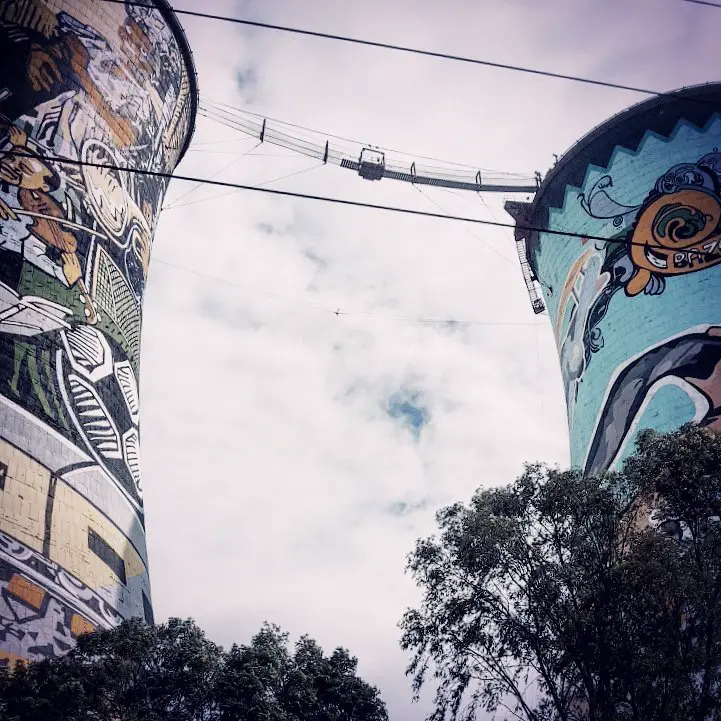
Our next stop was at two tall brightly painted buildings that I was told are iconic of Soweto, the 100-meter tall Orlando Towers.
Formerly the cooling towers of a now-decommissioned power plant, the Orlando Towers hover above the Soweto skyline and are now a location for extreme sports (I will have to travel back to Johannesburg one day so I can bungee jump there!)
Soweto Towers Activities and Prices/Towers in Soweto/Bungee Jumping in Sweto
If you would like to know more about bungee jumping from the Orlando Towers, click here.
We drove on past the Orlando Stadium (mostly used for football matches) and stopped at the Hector Pieterson Memorial and Museum.
Soweto Towers Using Box’s
If by “Soweto Towers using box’s” you mean the structure or construction of the Soweto Towers, there is an interesting distinction worth making.
The famous towers are not ordinary box-shaped buildings.
They are the two huge former cooling towers of the Orlando Power Station in Orlando East, Soweto.
Soweto Towers and Their Original Purpose
The two towers were built as part of the Orlando Power Station, which was constructed to support Johannesburg’s growing electricity needs. The cooling towers were built in the early 1950s and were used as part of the power station’s cooling system. Each tower rises roughly 100 metres above the ground, making them highly visible landmarks in Soweto.
The power station eventually stopped operating in 1998. Rather than remaining an abandoned industrial site, the towers were transformed into an entertainment and adventure attraction.
What Are the Towers Used for Today?
The towers now form a vertical adventure centre.
Activities include:
- 100-metre bungee jumping from the suspension bridge between the towers
- Straightjacket bungee jumping
- SCAD freefall
- 700-metre ziplining
- Base jumping for experienced jumpers who meet the requirements
- Paintball
- Viewing from the tower via the lift
The official entrance fee is currently R20 per person, while individual adventure activities have their own charges.
The towers are also famous for their enormous murals.
One tower carries artwork depicting aspects of township culture, while the other has carried major commercial branding.
This has made the former industrial structures an instantly recognisable part of the Soweto landscape.
https://visit.gauteng.net/Visit/Soweto-Towers-Gn?UTM
The page above is about the Soweto Towers, also widely known as the Orlando Towers. They are two former cooling towers of the Orlando Power Station in Soweto, Johannesburg, that have been turned into a major adventure attraction.
What Are the Soweto Towers?
The Soweto Towers are a pair of enormous 33-storey cooling towers in Klipspruit, Soweto.
They were originally part of the Orlando Power Station, a coal-fired power station whose construction began in 1935 and was completed in 1955. The power station eventually shut down in 1998.
Rather than being demolished, the towers were given a new purpose.
The Orlando Towers adventure facility opened in 2008, turning the old industrial structures into a vertical adventure centre.
Why Are They Famous?
One of the biggest claims to fame of the towers is that they became the site of what is described as the world’s first bungee jump between two cooling towers.
Today, visitors can take part in several activities, including:
- Bungee jumping – jumping from one tower while attached to a bungee cord.
- SCAD freefall – a suspended freefall experience between the towers.
- Abseiling – descending the side of a tower using ropes.
- Zip-lining
- Pendulum swinging
- Rock climbing
- Paintball
- Quad-bike tours of Soweto
The towers therefore offer something quite different from the historical and cultural attractions usually associated with a visit to Soweto.
The Murals
The towers are also famous for their enormous, brightly coloured murals.
The two towers have different designs.
One features imagery associated with township culture, while the other carries branding associated with FNB, one of South Africa’s major banks.
The artwork makes the towers particularly conspicuous against the Soweto landscape.
Where Are the Soweto Towers?
They are on Chris Hani Road in Klipspruit, Soweto, Johannesburg.
The attraction is particularly easy to recognise because the two tall towers rise dramatically above the surrounding area.
Some Practical Details
The adventure activities are affected by weather conditions, especially wind.
Participants under 18 need parental or guardian consent. For bungee jumping specifically, the listed weight range is 35 kg to 110 kg.
The attraction also states that activities are tested by certified rope-access technicians and subject to external safety auditing.
The attraction’s currently listed hours are 10:00 a.m. to 5:00 p.m. daily.
Why the Towers Are Interesting
What makes the Soweto Towers particularly interesting is their transformation from industrial infrastructure into a tourist landmark. They began as part of a power station that supplied electricity and ended up becoming one of Soweto’s most recognisable landmarks and an unusual destination for adventure tourism.
So, if you came across “Soweto Towers” while researching Soweto, these are the towers the Visit Gauteng page is referring to. “Orlando Towers” is the other name you are likely to encounter.
Soweto 5 Facts
If you are looking for Soweto 5 facts, here are five useful facts that give you a quick picture of this important South African township.
1. Soweto Is in Johannesburg
Soweto is a large urban settlement situated to the southwest of Johannesburg, in Gauteng, South Africa.
The name refers to a collection of townships rather than a single township that developed at one particular moment. Its history stretches back more than a century.
The area grew partly because Black South Africans were increasingly pushed into segregated residential areas under South Africa’s segregationist and later apartheid system.
2. Soweto Means “South Western Townships”
The name Soweto is an abbreviation of South Western Townships.
The name was adopted in 1963 after a competition to find a collective name for the townships southwest of Johannesburg.
Soweto is therefore not an indigenous African word, even though it has become one of the most recognisable place names in South Africa.
3. Soweto was the centre of the 1976 student uprising
One of the most important facts about Soweto is its connection with the Soweto Uprising of 16 June 1976.
Thousands of Black schoolchildren took part in a protest against the apartheid government’s requirement that Afrikaans be used as a language of instruction in their schools. The march began peacefully, but police opened fire on the students. The violence spread through Soweto and subsequently to other parts of South Africa.
The events of June 16 are now commemorated every year in South Africa as Youth Day.
4. Soweto was home to Nelson Mandela
Nelson Mandela lived at 8115 Orlando West, now known as Mandela House.
Mandela moved into the house in 1946 with his first wife, Evelyn Mase.
His second wife, Winnie Madikizela-Mandela, later lived there with him. The house is now a museum on Vilakazi Street.
Vilakazi Street is particularly notable because it has been home to two Nobel Peace Prize laureates, Mandela and Archbishop Desmond Tutu.
5. Soweto is closely associated with South African football
Football is deeply connected with Soweto’s history and culture. Several major South African football clubs have roots in the township, including Orlando Pirates, Kaizer Chiefs, and Moroka Swallows.
Orlando Pirates and Kaizer Chiefs are particularly famous for their rivalry, known as the Soweto Derby.
Soweto also has a strong cultural identity extending beyond politics and football, with important contributions to South African music, literature, arts and popular culture.
In short: Soweto is a large collection of townships southwest of Johannesburg, its name means South Western Townships, it became internationally known through the 1976 student uprising, it was home to Nelson Mandela and other major figures in South African history, and it has a particularly strong football and cultural identity.
Things to Do in Soweto #4: Visit the Hector Pieterson Memorial and Museum
Hector Pieterson, who died at the age of 13, was among one of the first fatalities of the 1976 Soweto uprising.
He was killed when police opened fire on a student demonstration protesting a new law instating Afrikaans as a medium of instruction.
As we stood there, not far from the corner where Hector was killed, listening to our guide tell us what occurred on that fateful day, I got a glimpse of how horrific life in apartheid South Africa must have been for Sowetans.
Things to Do in Soweto #5: Explore Vilakazi Street
I left that stop with a heavy heart. Still, nothing was going to dampen my pleasure of being on Vilakazi Street.
It was right around the corner and our next stop.
The first place we came to on Vilakazi street was Nelson Mandela’s former home.

Things to Do in Soweto #6: Tour Mandela House
Currently a museum, Mandela House is open to the public though an entry fee is charged to go inside.
Soweto Day Tour
Before I started my tour of Soweto, I hadn’t realized that the two-hour City Sightseeing Joburg Soweto Tour extension would only allow for perfunctory stops at each point of interest.
If I had, I would have planned enough time in Soweto to actually visit the main attraction at each stop. This would have been quite easy to do.
All it would have taken would have been staying at a stop until the next scheduled bus came along.
This portion of the tour, like the rest of the City Sightseeing Joburg tour, is hop-on, hop-off.
My travel companion and I took pictures to commemorate the fact that we’d been there. Then we got back into the van for the rest of the tour.
We didn’t stop at Archbishop Tutu’s house because it’s still a private residence and is not open to the public.
Still, at least I can say: I have been to Vilakazi Street. I can also say that I have seen both houses for which it is famous!

What to Do in Soweto #7: Visit Kliptown
The last two stops we made before returning to Gold Reef City were both in Kliptown.
Soweto Attractions #8: Explore Walter Sisulu Square
The first was Walter Sisulu Square where in 1955 the Freedom Charter was signed, and the second was on the side of the road near a shanty town where I saw the abject poverty that I thought would characterize so much more of Soweto (I am glad I was wrong!).
After those two stops, our tour was complete and we made our way back to Gold Reef City.
READ ALSO: 10 Best Experiences to Have in South Africa
It’s rare, in my life, for me to visit a place and find that I had such great misconceptions about it—I like to think of myself as a generally informed person.
Soweto, however, got me.
Much larger than I had imagined, Soweto is truly a city within a city, with so much to see.
If you, like me, happen to be in Johannesburg and are determined to visit Soweto but are not sure how, then I highly recommend City Sightseeing Joburg’s Soweto Tour extension.
Remember you can join the greater tour from the Gautrain Park Station or from Gold Reef City.
If you do, please let me know what you think.
Until the next time,
Biche
Photo Credits: Getty Images