Glossy babylights on black hair are a beautiful way to add fine, light-catching dimension without turning the hair into a head full of obvious highlights.
The key is that the individual strands are extremely fine, so the finished color reads more like subtle flashes of brown, caramel, copper, or even beige when the hair moves or catches the light.
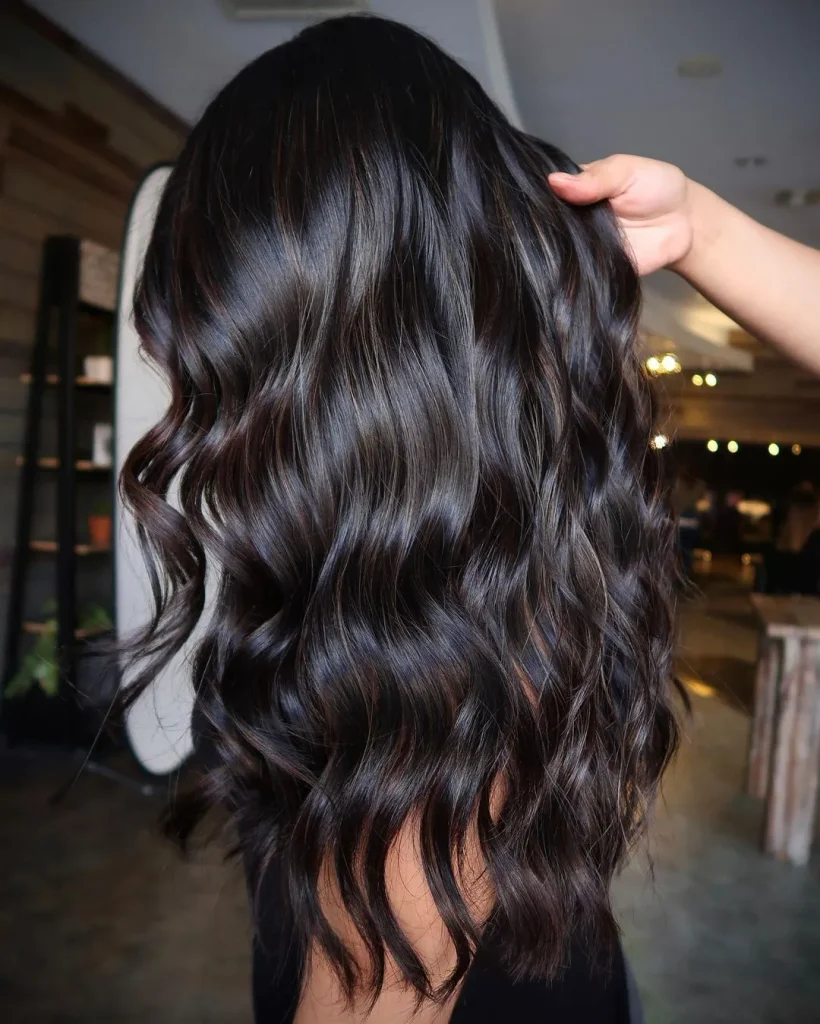
Table of Contents
What Makes Babylights Different?
Babylights are much finer than traditional highlights. Instead of creating obvious ribbons of color, a stylist weaves very small sections of hair and lightens them, usually using foils.
The result is a softly blended change in tone rather than clearly defined streaks.
On black hair, that fine placement matters. Thick blonde highlights can create a strong stripe-like contrast, while very fine babylights can give black hair a brownish shimmer and greater visual dimension.
Why Glossy Babylights on Black Hair Work Particularly Well & Gloss Brown Babylights on Black Hair
Black hair has a naturally deep visual base, so even a relatively small amount of lighter color can become noticeable when light hits it.
A gloss or toner over the finished highlights can help unify the different tones and give the hair a reflective finish.
One particularly subtle approach is espresso-brown babylights. These sit relatively close to black, so you may barely notice them indoors, while sunlight reveals the warmer brown dimension.
L’Oréal specifically highlights ultra-fine espresso brown babylights around the face as an option for black hair.
For a little more contrast, you could move toward:
- Dark chocolate — rich and understated
- Chestnut brown — warmer and visibly dimensional
- Caramel — brighter and warmer
- Honey brown — noticeable without necessarily becoming blonde
- Copper brown — adds warmth and a reddish glow
- Ash brown — cooler and smokier
- Beige or dark blonde — more contrast while still keeping the highlights fine
Brown is particularly easy to integrate into black hair because the contrast can be adjusted gradually rather than jumping straight from black to blonde.
The Really Glossy Version
If the goal is specifically glossy babylights on black hair, I would think about the look as three parts:
deep black or near-black base + extremely fine lighter pieces + an overall shiny finish.
The lighter pieces don’t necessarily have to be very light. In fact, going only a few levels lighter can make the finished result look particularly rich.
One professional example of babylighting very dark level-1 hair uses numerous fine foils and then tones the result, demonstrating how much technical work can go into creating very subtle dimension on a black base.
A gloss can also be used to make dark hair look more reflective.
For dark straight hair, celebrity colorist John Clark has described using ultra-fine babylights together with a gloss to create a multidimensional brunette effect with a candlelit quality.
Placement of Gloss Babylights on Black Hair Makes a Big Difference
You don’t have to distribute the babylights evenly from root to tip.
Face-framing babylights can concentrate the brightness around the hairline and front sections.
This gives you a visible change without committing to a heavily highlighted head.
Crown babylights create little flashes of brightness when the hair moves or is parted.
Full-head babylights give a more dimensional result, particularly when the goal is to make solid black hair look less flat.
For curly or coily hair, fine highlights distributed through the body of the hair can also make the curl pattern more apparent because different strands catch the light differently.
Photo credits: Ricardo