Inurl:/Sitesummary/WWW
If you would like to know more about inurl:/sitesummary/www, click here.
Table of Contents
Inurl:/Sitesummary/WWW Game
If you would like to know what this phrase means, click here.
Indigenous Board Games
Indigenous board games are much more than simple ways of passing time.
Across Africa, Asia, the Americas, Oceania, and other regions, communities developed games using materials that were readily available around them: seeds, stones, shells, sticks, carved pieces, and even holes scratched directly into the ground.
What makes many indigenous board games particularly interesting is that they often combine strategy, mathematics, memory, observation, social interaction, and cultural knowledge.
African Indigenous Board Games
Africa has an especially rich tradition of indigenous board games. One of the largest families is mancala, although “mancala” is better understood as a broad family of related games rather than one single game.
Different communities developed their own boards, rules, names, and styles of play.
The basic idea in many mancala games is deceptively simple.
Players distribute seeds or stones among a series of hollows or pits, a process usually called sowing.
But the strategic possibilities can become remarkably complicated.
Indigenous Games in Kenya/Indigenous Game in Kenya/Indigenous Kenyan Game: Bao
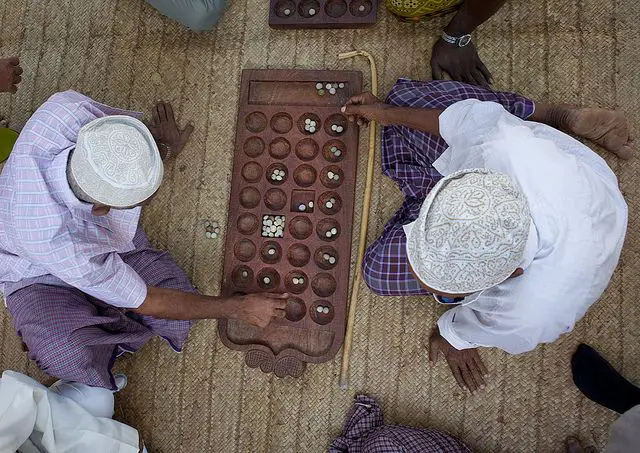
Bao is one of the most important traditional board games of East Africa. It is particularly associated with the Swahili-speaking communities of Tanzania and Kenya and is also played in parts of Uganda, Rwanda, Malawi, Burundi, the Comoros, and the Democratic Republic of Congo.
Bao is played on a four-row board and is considerably more complicated than the familiar two-row versions of mancala.
The game involves planning several moves ahead, manipulating groups of seeds, and anticipating the opponent’s responses.
In Zanzibar and coastal Tanzania, Bao has traditionally been more than a children’s pastime.
Highly skilled players can earn considerable respect, and the game has a strong social dimension.
It is a game that rewards experience because recognizing patterns and understanding the consequences of a move become increasingly important as players improve.
Examples of Indigenous Board Games #2: Omweso
Omweso is another sophisticated four-row mancala game, traditionally associated with the Baganda of Uganda. Like Bao, it is played with seeds and requires substantial strategic thinking. Research into African mancala games has found Bao and Omweso to be among the particularly complex examples in terms of the number of possible game positions and sequences of play.
Oware
In West Africa, Oware is one of the best-known traditional games.
It is associated particularly with the Akan peoples of Ghana and is also known by related names such as Wari, Awari, Awele, and Ayo in different places.
A standard Oware board has two rows of six pits. Traditionally, four seeds are placed in each pit at the beginning. Players then distribute seeds around the board and attempt to capture their opponent’s seeds.
The interesting part is that Oware isn’t simply about accumulating pieces. You have to think about where your move will leave seeds for your opponent, what positions you are creating for yourself, and whether a future capture is possible.
Oware also illustrates how indigenous games could function as social activities.
Traditionally, spectators might watch games, comment on moves, offer advice, and engage in conversation around the players.
The game has also been used in informal mathematical learning, particularly in developing children’s understanding of counting and arithmetic. I grew up in the Ivory Coast and spent countless hours playing Awale with my older brother. It was lots and lots of fun!
Igisoro
Igisoro, associated particularly with Rwanda, is another four-row mancala game. It uses an 8-by-4 arrangement of pits and 64 seeds, with each player controlling two rows.