Here’s a clear, practical comparison of Equity Bank vs KCB for small business loans in Kenya, focusing on what matters most if you’re an SME owner: rates, approval style, limits, and who each bank tends to suit best.
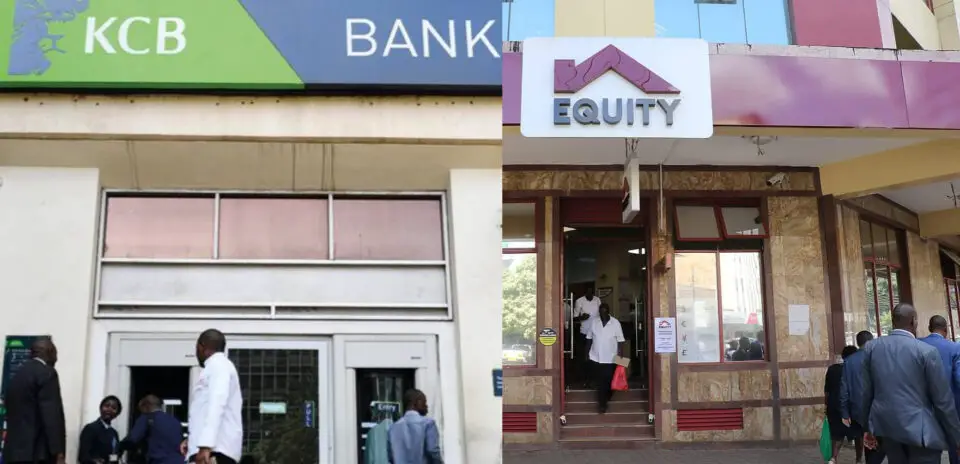
Table of Contents
Big Picture
- Equity Bank is widely seen as the most SME-focused bank in Kenya and lends heavily to micro and small businesses.
- KCB Bank is larger by assets and offers bigger loan ceilings and strong digital lending options.
Both are Tier-1 banks and compete closely on interest rates and SME support.
Interest Rates (2025–2026 Trends)
- Equity Bank: roughly mid-teens (around ~14–16% base depending on risk profile).
- KCB Bank: similar range, sometimes slightly higher average lending rate.
In practice, rates are now very close, because both banks adjust pricing based on:
- credit score
- collateral
- business cash flow
- Central Bank rate changes
Takeaway: No clear winner on interest alone anymore.
Loan Sizes & Limits
KCB
- Higher maximum SME limits (up to hundreds of millions secured).
- Unsecured loans up to a few million shillings.
- Designed to scale with growing businesses.
Equity
- Strong for micro and small loans.
- Often more flexible for smaller ticket sizes.
Verdict:
- Big expansion capital → KCB
- Small working capital → Equity
Collateral & Approval Style
Equity Bank
- Known for lending based on cash flow and inclusion, not just assets.
- Some unsecured SME loans and women-focused programs (e.g., Fanikisha).
- Faster approvals for small borrowers.
KCB
- More structured underwriting.
- Unsecured loans exist but often require strong transaction history.
- Better if your books are formal and documented.
Verdict:
- Informal or semi-formal businesses → Equity
- Structured businesses → KCB
Digital Lending & Accessibility
KCB
- Strong mobile lending ecosystem (e.g., digital SME and mobile loans).
- Useful if you want fast short-term capital.
Equity
- Massive branch network and strong SME ecosystem support.
- Also strong mobile banking but more branch-driven for business clients.
SME Support Ecosystem
Equity
- Historically the biggest SME lender by volume.
- Offers:
- business training
- microfinance-style lending
- grassroots outreach
KCB
- Strong SME clubs and networking platforms (like Biashara Club).
- Often appeals to mid-tier SMEs and growing corporates.
Processing Fees & Costs
Typical patterns across Kenya:
- Equity: ~2% processing fee.
- KCB: slightly higher (~2.5% typical).
This varies by product, but Equity often edges lower on upfront costs.
Equity Bank vs KCB for Small Business Loans in Kenya: Which Bank Is Better for Small Business Loans?
Choose Equity If:
- Your business is small or informal
- You lack collateral
- You want faster approvals
- You’re a trader, startup, or women-owned SME
Why: More inclusive lending model.
Choose KCB if:
- You need large capital
- You have proper books and statements
- You want to scale regionally
- You prefer digital loan access
Why: Larger limits and structured financing.
Simple Verdict
- Micro and early-stage SMEs: Equity usually wins
- Growth-stage SMEs: KCB often becomes more attractive
- Interest rates: Nearly tied in recent years
READ ALSO: On Banking
Between KCB and Equity Which Is Better?
Whether KCB or Equity Bank is “better” depends on what you’re looking for—each bank has different strengths.
Here’s a comparison across key areas to help you decide which might suit your needs better:
KCB vs Equity Bank Consideration #1. Size and Stability
- KCB is slightly larger in terms of total assets and is considered more established, with deeper historical roots.
- Equity has grown rapidly, especially over the last two decades, and now rivals or surpasses KCB in several areas, including customer base.
Verdict:
KCB is seen as more “traditional” and stable. Equity is aggressive and growth-focused.
Between Equity Bank and KCB Bank Which is Better Consideration #2. Innovation and Technology
- Equity Bank leads in digital banking, mobile platforms (EazzyBanking App, Equitel SIM), and agency banking. It has pioneered access for low-income earners and rural communities.
- KCB is also strong digitally (KCB M-Pesa), but Equity generally moves faster with tech adoption.
Verdict:
Equity is more innovative and accessible via mobile/agents.
3. Customer Service
- Equity Bank often ranks higher for accessibility due to its massive agent network, but some users complain about long queues at branches and customer care delays.
- KCB is considered more polished in corporate customer service but may be slower for lower-tier customers.
Verdict:
Equity is better for fast, everyday services. KCB is often better for high-value or corporate customers.
4. SME and Personal Loans
- Equity Bank is well-known for friendly terms for small business loans and has been more inclusive of first-time borrowers.
- KCB also offers solid lending but is more conservative in credit risk.
Verdict:
Equity tends to be more accommodating for SMEs and hustlers.
5. ATM and Branch Network
- Both have extensive branch and ATM networks, though Equity edges ahead in rural outreach through agents.
Verdict:
Equity wins for reach, especially in underserved areas.
6. Corporate and Institutional Banking
- KCB has an edge in this space. It handles many government and large enterprise accounts and has more corporate experience.
Verdict:
KCB is stronger for large business or government-related banking.
Overall Summary
| Feature | Winner |
|---|---|
| Stability | KCB |
| Innovation & Mobile Banking | Equity |
| Customer Service (mass) | Equity |
| SME Focus | Equity |
| Corporate Services | KCB |
| Rural Access | Equity |
So, Between KCB and Equity Which Is Better?
- Choose Equity if you’re an individual or small business looking for convenience, mobile banking, and wide access.
- Choose KCB if you prioritize stability, have corporate banking needs, or prefer a traditional bank structure.
Photo credit: Bizna