Jumamosi in English/Jumamosi Meaning/Saturday in Swahili/Juma Mosi in English
The first day of the week in Swahili culture is Saturday or Jumamosi (‘day one’).
If you can remember this main difference in how the week is structured in Swahili vs. English, this will go a long way in helping you learn and remember the days of the week in Swahili.
Ok, so now…let’s get to it.
READ ALSO: How to Express Costume in Swahili Accurately Today in 2026 & More
Table of Contents
Palm Sunday in Swahili (& Jumapili in English)
Palm Sunday in Swahili is commonly called “Jumapili ya Matawi.”
- Jumapili = Sunday
- Matawi = branches (especially palm branches)
So the name literally means “Sunday of branches,” referring to the palm branches used during the celebration.
Palm Sunday, or Jumapili ya Matawi, is an important day in Christianity.
It falls on the Sunday before Easter and marks the beginning of Holy Week.
On this day, Christians remember when Jesus Christ entered Jerusalem and was welcomed by crowds who waved and laid down palm branches in his path as a sign of honor and praise.
In many Swahili-speaking communities across East Africa, including Tanzania and Kenya, the celebration has a very recognizable style. Churches often hold processions where people walk while holding palm leaves.
These leaves are usually blessed during the service. Afterward, many people take them home and keep them as a symbol of faith and blessing.
In Swahili church language, you might hear phrases like:
- “Yesu aliingia Yerusalemu kwa shangwe” (Jesus entered Jerusalem with celebration)
- “Hosana!” (a word of praise also used in the Bible accounts of the day)
The meaning behind Jumapili ya Matawi goes beyond just the branches.
It represents humility and peace. Jesus entered the city riding a donkey, not a horse, which symbolized that he came as a peaceful king rather than a warrior.
In Uganda and other parts of East Africa, it is common to see people carrying fresh palm leaves to church early in the morning.
The atmosphere is often lively, with singing, prayers, and sometimes outdoor processions.
The day also prepares Christians for the events that follow during the week, including Good Friday and Easter Sunday.
In simple terms, Jumapili ya Matawi is:
- A day of remembrance
- A day of celebration
- The beginning of the most important week in the Christian calendar
Mosi in Swahili
The Swahili word mosi has a few related meanings, depending on how it is used.
Although it is less common in everyday speech than moja, it remains an important word in Swahili vocabulary and appears in names, dates, and traditional expressions.
The primary meaning of mosi is “one” or “first.” In modern Swahili, moja is the standard word for the number one when counting or describing quantity. For example:
- Nina kitabu kimoja. – I have one book.
- Moja, mbili, tatu… – One, two, three.
By contrast, mosi is generally used in more specific or traditional contexts rather than ordinary counting.
It can refer to the concept of the number one or first in a sequence.
One of the most familiar places where people encounter mosi is in the word Jumamosi, which means Saturday. The name combines juma (week) and mosi (first), reflecting the traditional Swahili and Islamic convention of treating Saturday as the first day of the week. This is why Saturday is called Jumamosi, Sunday is Jumapili (“second”), Monday is Jumatatu (“third”), and so on.
Mosi is also used as a given name in Swahili-speaking communities.
As a personal name, it traditionally means “first child” or refers to the eldest child in a family.
The name may be given to either a boy or a girl, making it a unisex name. In this context, it symbolizes the importance of being the firstborn.
Although mosi and moja are closely related, they are not always interchangeable. In everyday conversation, moja is the form that Swahili speakers almost always use for counting and describing quantity. Mosi survives mainly in fixed expressions, names, and certain grammatical or literary contexts. For this reason, someone learning Swahili will hear moja far more frequently than mosi.
Here are a few examples showing the different uses:
- Moja – one (general counting)
- Mosi – first, the number one, or used in fixed expressions
- Jumamosi – Saturday
- Mei Mosi – May 1 (May Day or International Workers’ Day)
In summary, mosi is an older but still meaningful Swahili word that means one or first. While moja is the standard word for “one” in everyday speech, mosi continues to appear in the names of days, personal names, and established expressions, preserving an important part of Swahili linguistic and cultural heritage.
Days of the week in Swahili are one of the hardest things to learn for English speakers.
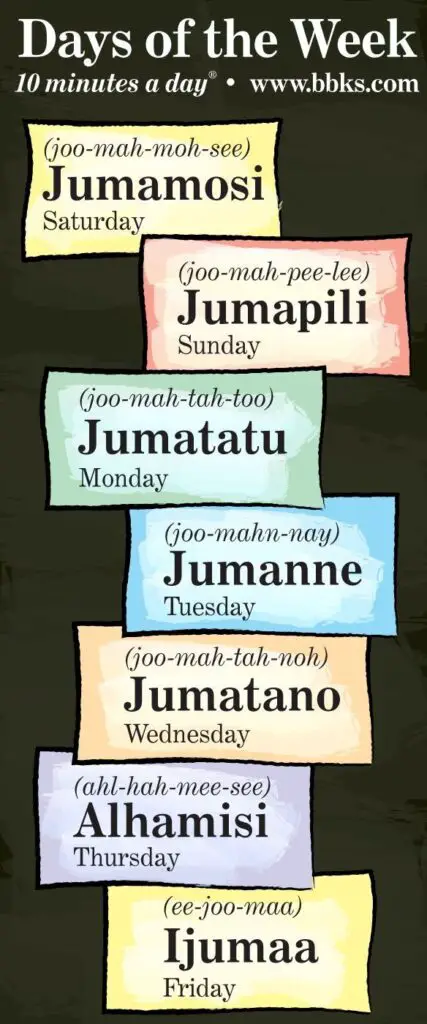
Even though Swahili was my first language (but English is now my primary language), and I have been living in Tanzania for over a decade, I still get tripped up about the days of the week sometimes and have to do a mental count to get it right.
Before I actually begin to tell you what the days of the week are in Swahili, let me begin to tell you about how the week is structured in the Swahili language.
In most of the English-speaking world (which has historically been mostly Christian), Sunday is the holy day of the week and so the new week begins on Monday, the following day.
In the primarily Muslim Swahili-speaking part of the world, the Holy Day of the week is Friday or Ijumaa.
READ ALSO: Days in Swahili
Days of the Week in Swahili and English (Including Jumatatu in English)
- Day 1 of the week (Saturday) is Jumamosi (literally ‘day one’).
- Day 2 of the week (Sunday) is Jumapili (literally ‘second day’).
- Day 3 of the week (Monday) is Jumatatu (literally ‘third day’).
- Day 4 of the week (Tuesday) is Jumanne (literally ‘day four’).
- Day 5 of the week (Wednesday) is Jumatano (literally ‘day five’).
Alhamisi in English
Then for the last two days of the week, things switch up a bit:
- Day 6 of the week (Thursday) is Alhamisi, and
- Day 7 of the week, the Holy Day (Friday) is Ijumaa.
That is it: that is how you say the days of the week in Swahili. Good luck on learning and rememebering them.
Photo credit: LizMundi1