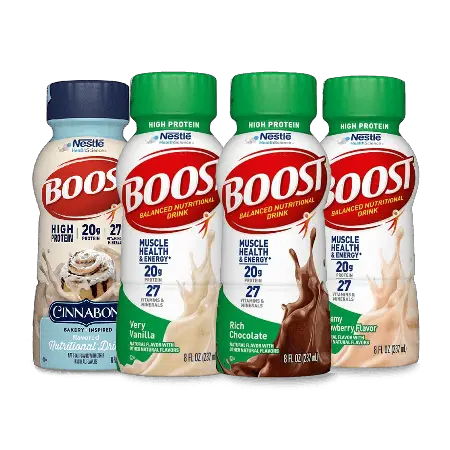
A Boost beverage is a ready-to-drink nutritional supplement designed to provide calories, protein, vitamins, and minerals in a convenient liquid form.
These drinks are produced by the company Nestlé and are commonly used by people who need extra nutrition, have a low appetite, or want an easy way to supplement their daily diet.
Table of Contents
What a Boost Beverage Is & Boost Drink Nutrition
Boost beverages are formulated to deliver balanced nutrition in a small serving.
A typical bottle contains protein for muscle support, carbohydrates and fats for energy, and a wide range of added vitamins and minerals.
Many versions contain around 26–27 essential nutrients such as vitamins C and D, calcium, iron, zinc, and selenium.
Because they are easy to drink and calorie-dense, Boost beverages are often used as:
- A nutritional supplement when someone is not eating enough food
- A mini-meal or snack during busy days
- A support drink for people recovering from illness or surgery
- A weight-gain aid for those who need extra calories
Common Types of Boost Beverages
Boost comes in several different formulas, each designed for slightly different nutritional needs.
Boost Original
This is the standard version.
A typical serving provides about 240 calories and 10 grams of protein, along with a full range of vitamins and minerals.
Boost Plus
This version is designed for people who need more calories.
One serving contains about 360 calories and 14 grams of protein, which can help with weight gain or maintaining weight.
Boost High Protein
This variety focuses on protein intake, providing around 20 grams of protein and about 250 calories to support muscle health.
Boost Very High Calorie (VHC)
This is the most calorie-dense formula.
A small serving can contain about 530 calories and 22 grams of protein, making it useful for people who need significant calorie support but cannot consume large volumes of food.
Ingredients Typically Found in Boost Beverages
Although formulas vary slightly, many Boost drinks include:
- Water
- Milk protein or soy protein
- Sugars or glucose syrup
- Vegetable oils such as canola oil
- Added vitamins and minerals
- Stabilizers and thickeners (such as gums or carrageenan)
These ingredients allow the drink to deliver concentrated nutrition while maintaining a smooth, drinkable texture.
How Boost Beverages Are Usually Consumed
Most people drink Boost as a supplement rather than a full replacement for regular meals. It can be used:
- Between meals for extra calories and protein
- When appetite is low
- As part of a medically supervised nutrition plan
Some people also use them during busy periods when preparing a full meal is not practical.
Things to keep in mind
While Boost beverages can be helpful for increasing calorie and nutrient intake, they are still processed products. Some versions contain significant amounts of added sugars and are designed for specific nutritional needs rather than everyday casual drinking. For many people, they work best as an occasional supplement to a balanced diet that includes whole foods.
In short, a Boost beverage is a convenient way to add calories, protein, and micronutrients to your diet, particularly when regular meals are difficult to manage or when extra nutritional support is needed.
Dangers of Drinking Boost
Drinking Boost nutritional drinks can be helpful in certain situations, especially for people who need extra calories or nutrients. However, like many processed nutritional supplements, there are potential downsides to be aware of, particularly if they are consumed frequently or in large amounts.
High sugar content
Many Boost formulas contain a significant amount of carbohydrates and added sugars. Regular consumption of sugary beverages can contribute to weight gain and may raise blood sugar levels, which can be a concern for people with diabetes or those trying to control their glucose levels.
Boost Nutritional Drink Side Effects: Digestive problems
Some people experience stomach discomfort after drinking Boost. Reported issues include bloating, gas, nausea, constipation, or diarrhea. These symptoms may be related to ingredients such as milk proteins, soy proteins, sweeteners, or sugar alcohols that can be difficult for certain people to digest.
Boost Drink Side Effects: Allergic reactions or sensitivities
Boost drinks often contain ingredients derived from milk or soy. Individuals with sensitivities or allergies to these ingredients may experience symptoms such as itching, rash, fatigue, or digestive upset after consuming them.
Potential strain on kidneys for some people
Some Boost varieties are relatively high in protein. For healthy individuals this is usually not a problem, but people with existing kidney disease may need to limit protein intake.
Excess protein can place additional stress on the kidneys and may worsen kidney problems if consumed regularly in large amounts.
Interaction With Certain Medications
Boost drinks contain significant amounts of vitamins and minerals, including vitamin K. High vitamin K intake can interfere with blood-thinning medications such as warfarin, potentially reducing their effectiveness.
Not Ideal as a Long-Term Meal Replacement
Although Boost drinks contain vitamins and minerals, they are still processed products and are typically intended to supplement meals rather than replace them. Relying heavily on liquid nutritional drinks may crowd out whole foods that provide fiber and other beneficial nutrients.
Who should be cautious
Extra care may be needed for:
- People with diabetes or blood-sugar concerns
- Individuals with kidney disease
- Those with milk or soy allergies
- People taking blood-thinning medications
Bottom line
Boost drinks can be useful for short-term nutritional support or when appetite is low, but drinking them frequently or relying on them as a regular substitute for balanced meals may lead to unwanted side effects. For most people, they are best used occasionally or under medical guidance rather than as a daily staple.
Photo Credits: Nestlé
One of the ingredients in Boost is Carrageenan> Is there
any danger with this ingr
Hi Stephen,
Welcome to Chick About Town! I am not a doctor, so I can’t answer your question directly, but here is what ChatGPT had to say about that:
Carrageenan is a **common thickener and stabilizer** made from red seaweed. It’s used in many products, including some formulas of Boost. The safety question usually depends on *which type* of carrageenan is being discussed.
Here’s the clearest way to understand it:
—
## 1. There are two forms of carrageenan
**a) Food-grade carrageenan**
* This is the type used in drinks like Boost.
* It’s purified and approved for use in foods.
* Regulatory bodies (including the FDA and the EU) consider it safe at the levels used in beverages.
**b) Degraded carrageenan (also called poligeenan)**
* Not used in food.
* Lab studies show it can cause inflammation, but it is **not** the same as food-grade carrageenan.
Much of the controversy comes from studies done on *degraded* carrageenan, which is not allowed in food products.
—
## 2. So is food-grade carrageenan dangerous?
**Most evidence says it is safe for the general population**, but there are a few things worth noting:
### Potential concerns
* Some people report **digestive sensitivity** (bloating, cramps, or loose stools).
* Certain lab studies suggest food-grade carrageenan *may* trigger inflammation in the gut in very high doses, but human evidence is inconsistent.
* People with conditions like **IBS, IBD (Crohn’s, ulcerative colitis)** sometimes feel better avoiding it.
### For most people
* Consuming it occasionally or regularly in normal amounts (like 1 bottle of Boost a day) is generally not considered harmful.
—
## 3. Should you avoid it?
You might consider avoiding carrageenan **if**:
* You have a history of gut sensitivity.
* You notice discomfort after drinking products that contain it.
* You prefer minimal additives.
Otherwise, it’s generally fine.
—
## 4. Does Boost offer carrageenan-free versions?
Yes — some Boost products do not contain carrageenan, depending on the formula and region.
I hope you find that helpful!
Biche