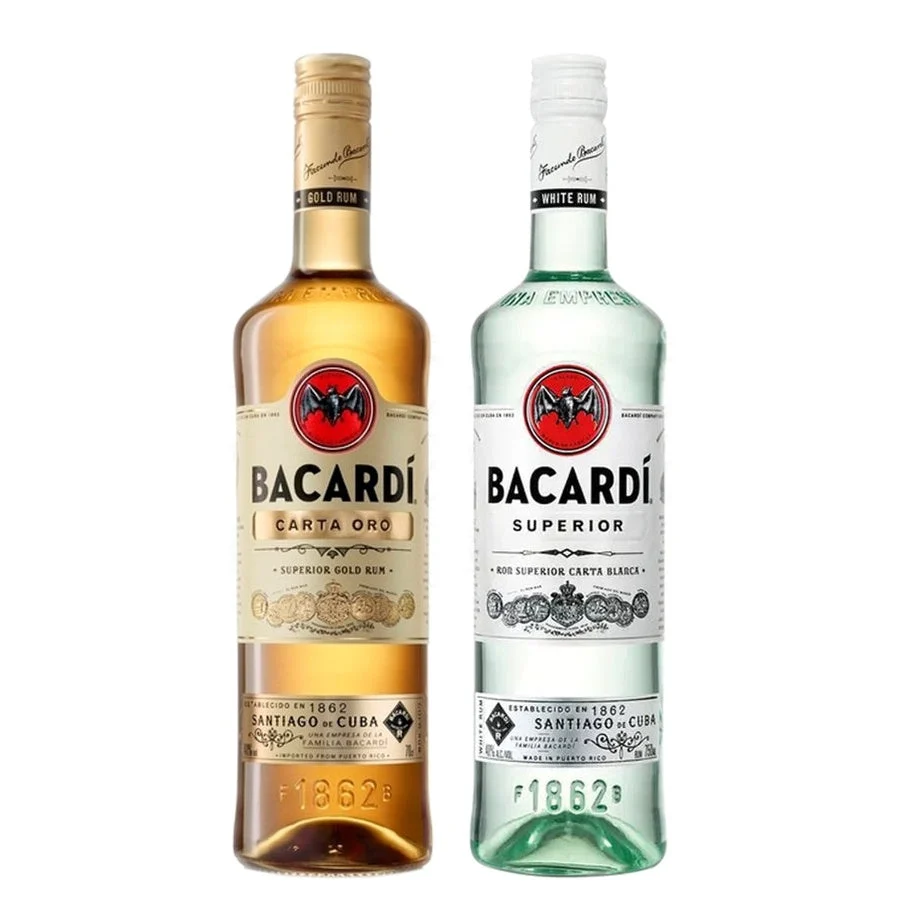
If you’ve ever stood in front of a shelf of rum and wondered about the different between bacardi gold and white, which one more popular, you’re not alone. Although both come from the Bacardi range, they have noticeable differences in color, flavor, and the types of drinks they work best in. Bacardi White is light and clean, while Bacardi Gold has a warmer, richer character with more pronounced vanilla, caramel, and oak notes. So, which one is more popular, and how do you decide which Bacardi is right for your drink? Let’s take a closer look at what sets these two rums apart.
READ ALSO: Bacardi Black vs Gold vs Superior: A Summary & More
Table of Contents
Different Between Bacardi Gold and White, Which One More Popular?: Bacardi White
Bacardi White is generally sold as Bacardi Superior or Bacardi Carta Blanca. It is a clear, light-bodied rum that is aged in American white oak and then charcoal-filtered. The filtration removes the color while retaining a light rum character.
Its flavor is relatively clean and subtle, with floral and fruity notes and hints of vanilla, almond, coconut and ripe banana. Bacardi specifically positions it as a mixing rum for drinks such as Mojitos and Daiquiris.
Think of White as:
- Light and clean
- Less pronounced rum flavor
- Excellent with lime, mint and fruit
- Very good for cocktails where you don’t want the rum to dominate
- Particularly suited to Mojitos, Daiquiris and other refreshing mixed drinks
Bacardi Gold Rum vs Superior Gluten Free Rum: Bacardi Gold
Bacardi Gold, also called Bacardi Carta Oro, is an amber/golden rum. It gets its color and richer character from its production in toasted oak barrels.
Bacardi describes its flavor as having vanilla, buttery caramel, toasted almond, banana and orange-peel notes, with a dry, slightly sweet finish.
Think of Gold as:
- Warmer and richer
- More noticeable rum flavor
- Slightly sweeter-tasting
- More oak and caramel character
- Particularly good with cola, ginger ale or ginger beer
- A good choice when you want the rum itself to contribute more flavor
Different Between Bacardi Gold and White, Which One More Popular?
Bacardi White appears to be the more widely used and commercially established of the two, particularly as a cocktail rum. There isn’t a current worldwide sales figure that cleanly compares Bacardi White versus Bacardi Gold as individual products, so I wouldn’t give you a precise percentage or claim that White outsells Gold globally.
There are, however, several indications of White’s much broader presence.
Bacardi’s white rum is the brand’s signature cocktail product, and Bacardi Superior has appeared among leading-selling rum SKUs in retail and on-premise sales data. Bacardi as a whole was also the second-highest-selling rum brand worldwide in 2024, with 19.7 million cases sold, although that figure covers the entire Bacardi portfolio rather than White alone.
So if you’re asking “Which Bacardi do more people generally know and use?”, I’d say White/Superior.
The interesting part: they suit different tastes
If you put the two in front of someone who normally drinks light, refreshing mixed drinks, White is probably the easier choice.
If someone likes drinks with a warmer, richer taste, they may prefer Gold.
For example:
Bacardi White + lime + soda/cola → light, crisp, refreshing
Bacardi Gold + cola → warmer, richer, more caramel/oak character
Bacardi White + mint + lime → classic Mojito territory
Bacardi Gold + ginger beer → more pronounced rum flavor
And there’s an important point if you’re choosing between them for drinking rather than simply comparing bottles: Gold isn’t “stronger” than White simply because it tastes richer or darker. Typical bottles of both are around 40% ABV, although the exact strength can vary by market. The difference you’re noticing is primarily the character of the rum, not the amount of alcohol.
Superior Bacardi Dark Rum
If you’ve come across the name Bacardi Superior Dark, there is an important distinction to make because Bacardi Superior and Bacardi’s dark rum are actually different products.
What Is Bacardi Superior?
Bacardi Superior is Bacardi’s classic white rum, not a dark rum.
It was introduced in 1862 and is known for its light, clean profile.
It has subtle almond and lime notes with hints of vanilla and a dry, crisp finish.
It is designed especially for mixing into cocktails such as Mojitos, Daiquiris, Piña Coladas and Cuba Libres.
It is also usually 40% ABV, although alcohol strength can vary by market.
What Is Bacardi’s Dark Rum?
The Bacardi dark rum you may be referring to is Bacardi Black, known as Bacardi Carta Negra in some markets.
It is a medium-bodied dark rum with a much deeper flavor profile than Superior.
Bacardi describes its flavor as having:
- Tropical fruit
- Molasses
- Caramel
- Vanilla
- Toasted and nutty aromas
- A smoky finish
Its darker flavors develop through maturation in heavily charred oak barrels.
So if someone says “Bacardi Superior Dark,” they may be combining the names of two different Bacardi products: Bacardi Superior (white) and Bacardi Black/Carta Negra (dark).
Bacardi Superior vs. Bacardi Black
The difference becomes quite noticeable when you taste them.
Bacardi Superior: light, crisp, relatively subtle and designed to blend easily with other ingredients.
Bacardi Black: darker, richer and more robust, with tropical fruit, molasses and smoky flavors that are much easier to notice in the finished drink.
This also means they behave differently in cocktails. Superior works particularly well when you want the other ingredients—such as lime, mint or fruit—to remain prominent. Black is useful when you want the rum to contribute a deeper, darker flavor.
Is Bacardi Black Actually Stronger?
Not necessarily. Dark does not mean higher alcohol content.
Bacardi Black is 40% ABV in the U.S., the same strength as Bacardi Superior there.
The stronger impression comes from its richer flavor, rather than necessarily having more alcohol.
There is also an interesting point about the word “dark.” Bacardi itself notes that rum color can provide clues about aging and flavor, but color alone doesn’t tell you everything about a rum. Dark rum tends to have a more intense profile, but production methods, blending, filtration and maturation all matter.
What about Bacardi Gold?
Bacardi also makes Bacardi Gold/Carta Oro, which sits between the white and dark styles in terms of color and flavor. It has notes of vanilla, buttery caramel, toasted almond, banana and orange peel, with a light oaky finish.
That gives you a useful three-way comparison:
| Bacardi | Style | General character |
|---|---|---|
| Superior | White rum | Light, crisp, clean |
| Gold / Carta Oro | Gold rum | Richer, vanilla, caramel, oak |
| Black / Carta Negra | Dark rum | Robust, tropical fruit, molasses, smoky |
So, if you have seen a bottle or listing specifically labelled “Bacardi Superior Dark,” I would check the bottle carefully. Superior is Bacardi’s white rum, while Bacardi Black/Carta Negra is its dark rum. They aren’t two versions of the same product.
Bacardi Superior Rum 2026 vs That Produced in 1980
If you compare Bacardi Superior produced around 1980 with Bacardi Superior sold in 2026, you are essentially comparing two generations of the same famous white-rum style. The name and basic concept have remained remarkably consistent, but an old bottle from 1980 should not automatically be assumed to taste exactly like today’s Bacardi Superior.
Bacardi Superior in 1980
Bacardi Superior was already a well-established product by 1980.
Bacardi had introduced Superior in 1862, and by the late 1970s the company was selling its rum on a huge international scale. In 1979, Bacardi reported worldwide sales approaching 16 million 9-liter cases.
An important detail is that Bacardi Superior wasn’t necessarily produced in one single distillery for the entire world. Bacardi operated in different markets and countries, so an early-1980s bottle could reflect the production location and market for which it was made.
For example, surviving vintage bottles of Bacardi Superior from Brazil have been identified as products of Bacardi’s Recife distillery and bottled during the 1980s. One such vintage bottle is listed as 40% ABV and 1 liter.
That means the exact characteristics of a 1980 bottle can depend on where it was produced, when it was bottled and how it was stored.
Bacardi Superior in 2026
Today’s Bacardi Superior is still a clear, light-bodied white rum, designed primarily as a mixing rum.
Bacardi describes its current profile as having subtle almond and lime, with hints of vanilla and a dry, crisp, clean finish.
It is aged in American white oak and then shaped through charcoal filtration.
The current U.S. version is 40% ABV. Bacardi also says its white rum is made from molasses, water and its distinctive Bacardi yeast, with blending, aging and filtration used to establish the final character.
So, What Would Actually Be Different?
The biggest mistake would be to assume that 1980 = much stronger or automatically better.
The alcohol content of an old bottle and a current bottle can be the same.
A vintage bottle from the 1980s can be 40% ABV, just like today’s U.S. Bacardi Superior.
The more interesting differences are likely to be in the production details and flavor.
| Bacardi Superior around 1980 | Bacardi Superior in 2026 | |
|---|---|---|
| Style | White rum | White rum |
| Color | Clear | Clear |
| Typical strength | Around 40% in documented bottles | 40% in the U.S. |
| Main purpose | Mixing | Mixing |
| Aging | Oak-aged production | American white oak aging |
| Filtration | Bacardi’s established charcoal-filtration tradition | Charcoal filtration remains part of the process |
| Flavor | Potentially different depending on production location and era | Light, dry, aromatic, citrus/almond/vanilla notes |
| Bottle | Vintage packaging and labeling | Modern packaging |
| Storage | Potentially decades of bottle storage | Freshly produced |
Would a 1980 bottle taste better?
There is no reliable rule that an unopened 1980 Bacardi Superior will taste better simply because it is old.
This is particularly important with rum. Unlike wine, a sealed bottle of distilled spirit generally does not continue aging in the bottle. A 1980 Bacardi Superior didn’t spend 46 years getting older inside the glass. Its maturation happened before bottling.
What can happen over decades is that storage affects the liquid. Evaporation, changes in the closure, oxidation from air entering the bottle and poor storage conditions can alter an old spirit.
So an exceptionally well-preserved 1980 bottle could be fascinating to taste, but that doesn’t mean its flavor is automatically superior to a fresh bottle.
Could the Old One Taste Different?
Yes, quite possibly.
Photo credits: BottleBuzz