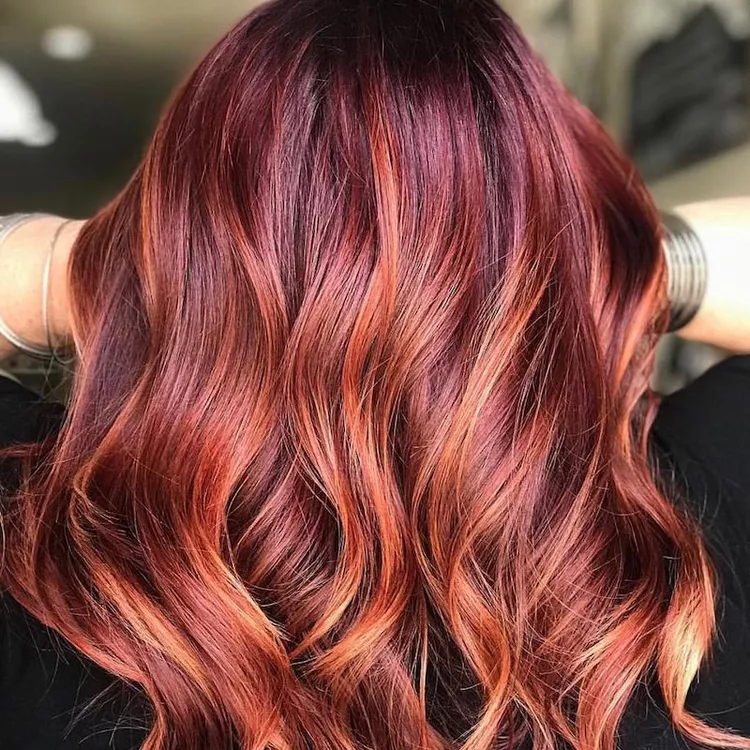
Copper mahogany hair color sits in an especially interesting spot between rich reddish-brown and warm copper. Traditional mahogany is a deep red-brown that can contain subtle violet or plum tones, while copper brings orange, gold, and red warmth into the mix. Put the two together and you get a deep, warm copper-red brown that has considerably more depth than bright copper hair.

Table of Contents
The exact result can vary quite a bit depending on how much copper versus mahogany is used. A copper-heavy version can look warm, glowing and distinctly orange-red in sunlight, while a mahogany-heavy version can look like a rich brown indoors with copper-red flashes when the light hits it.
What does copper Mahogany hair color look like?
Think of the difference this way:
- Mahogany: deep reddish brown, sometimes with a subtle violet cast
- Copper: brighter orange-red or golden-red
- Mahogany copper: brown depth + red richness + noticeable copper warmth
It is therefore darker and more subdued than a classic bright copper, but warmer and more visibly coppery than traditional mahogany.
Some professional color ranges specifically identify shades as dark copper mahogany or copper mahogany, so the terminology is used for real hair-color formulations rather than being purely an internet description.
Copper Mahogany Hair Color on Dark Hair
This is where the color gets particularly interesting.
If your natural hair is dark brown or black, applying a mahogany-copper color does not necessarily produce the same bright copper you might see in a photograph taken on light brown hair.
On a dark base, the result can be predominantly brown or dark red indoors, with copper and reddish reflections becoming much more obvious in sunlight.
If you want a subtle mahogany-copper effect, this can actually be desirable.
You get flashes of warm color without having an obviously orange head of hair.
If you want a much brighter copper result, however, the hair may need to be lightened first.
A copper-mahogany shade applied over very dark hair cannot simply make the underlying hair several levels lighter without the appropriate lifting process.
Copper Mahogany Colour on Hair – Natural Black Hair
For Black women with naturally very dark hair, I particularly like the idea of using the shade in different intensities.
You could have:
- Deep mahogany copper – mostly dark brown with a red-copper glow.
- Medium mahogany copper – clearly reddish brown with visible copper.
- Bright mahogany copper – a more obvious copper-red result with mahogany depth.
- Mahogany copper highlights – dark natural hair with strategically placed warm copper-brown pieces.
- Mahogany copper balayage – darker roots transitioning into warmer copper lengths.
- Copper-mahogany ends – particularly interesting on long natural hair or curls.
The darker versions can be especially striking on tightly curled, coily or textured hair because the different bends and surfaces catch the warm tones differently.
What Skin Tones Suit Copper Mahagong?
Mahogany copper generally works particularly well with warm and neutral undertones, because both mahogany’s red warmth and copper’s golden-orange qualities complement golden, peachy and warm complexions.
But you do not have to rule it out if your skin has cooler undertones. The balance of pigments can be adjusted.
A more mahogany-heavy version with red or violet influence will generally be cooler and less orange than a strongly copper version.
Mahogany itself can range from warmer red-brown to cooler violet-red depending on the formulation.
Mahogany copper vs auburn
These colors overlap, but they are not necessarily identical.
site:linkedin.com/in Narasience” (CEO or Founder or Owner or Direktur or Director or Principal or Coach or Head) “Indonesia””
This search phrase is a targeted Google-style query for finding Indonesian professionals on LinkedIn who have “narasience” in their profile or are associated with that term, while holding a leadership, ownership, coaching, or senior position.
The query is structured to look for LinkedIn personal profiles rather than company pages.
The key question is what “narasience” refers to, because it does not appear to be a standard English job title.
What the Search Brings Up
The exact term “narasience” did not produce a clear match.
However, the search surfaced these Indonesian LinkedIn profiles that illustrate the kinds of senior professionals your query is designed to find.
Johan Candra
Founder and CEO · PT Starfin Nawasena Indonesia
Works in management advisory, investment, risk management, and business coaching.
Hatta Kresna Aditya
Founder and CEO · Rahsa Nusantara
An entrepreneur working in biodiversity-based products, food systems, and community livelihoods.
Narasena
Full-stack software developer · Former founder and CEO
A technology professional whose profile mentions software development and previous entrepreneurial ventures.
These are related search results, not confirmed matches for “narasience.”
How to refine your search
Your original query can be simplified to:
site:linkedin.com/in "narasience" Indonesia
(CEO OR founder OR owner OR director OR principal OR coach OR head)
The word direktur is Indonesian for director, so including both direktur and director helps cover profiles written in either language.
Hair Color Copper Versus Mahogany Red Violet Undertone Professional Color Theory
Copper and mahogany red-violet belong to the red family of hair colors, but they create distinctly different results.
Copper is primarily orange-based, while mahogany red-violet combines red with violet and usually has a deeper, browner appearance. The difference affects how bright the hair looks, how warm or cool the color reads, and how a colorist formulates the shade.
1. Understanding the Two Colors
Copper hair color
Warm · Orange-based
Copper combines orange with varying amounts of red and sometimes gold. It can appear bright, fiery, golden, or earthy depending on its depth and formulation.
Typical impression: warm, bright, and distinctly orange-red.
Mahogany red-violet hair color
Red-violet · Brown-based depth
Mahogany combines red and violet pigments, often within a brown base.
Depending on the formula, it may look like deep reddish brown, plum-brown, or a rich red-violet shade.
Typical impression: deep, rich, red-toned brown with a plum or violet cast.
These are general color families.
Actual results vary by the shade’s depth, pigment proportions, lighting, and the hair’s starting color.
2. Professional Color Theory: What the Undertones Actually Do
A professional colorist considers three separate characteristics when choosing a hair color.
- Level: How light or dark the hair is, commonly measured on a scale from 1 (black) to 10 (lightest blonde).
- Tone: The dominant color direction, such as copper, red, violet, or ash.
- Reflect: The secondary hue that becomes noticeable in the light and adds complexity to the main shade.
Two colors can be at the same level but look completely different because their tones and reflects differ.
The color theory comparison
| Characteristic | Copper | Mahogany red-violet |
| Primary direction | Orange-red | Red-violet |
| Temperature | Warm | Often cooler than copper, but still red-based |
| Typical depth | Light to deep | Medium to deep, often brown-based |
| Visual effect | Brighter, more orange | Richer, more plum or reddish brown |
| Common color direction | Orange, gold, red | Red, violet, brown |
These are general tendencies, not fixed rules for every manufacturer’s color range.
Why the Violet Component Matters
Violet shifts a red-based shade away from the orange direction associated with copper. In a mahogany formula, it can create a plum-like or red-violet cast and contribute to a deeper-looking result.
The color wheel also explains why violet is used to neutralize yellow, while blue is used to neutralize orange.
However, adding violet to a formula does not automatically neutralize every warm pigment. The outcome depends on the exact pigments, their proportions, and the starting hair color.
3. Which color works better with different skin undertones?
Skin undertone is useful when choosing a hair color, but it should not be treated as a rigid rule. Both copper and mahogany red-violet can work across a range of complexions. Depth, saturation, and contrast affect the result.
Warm skin undertones
Copper can reinforce golden, peach, or yellow warmth. Mahogany can add richness without the same orange emphasis. If you prefer a warm, bright result, consider copper. If you prefer a deeper red-brown result, consider mahogany.
Cool skin undertones
A red-violet mahogany can complement pink or blue skin undertones. Copper can also work, especially when it is more red-based and less orange or gold.
Neutral Skin Undertones
Both color families are reasonable options.
Choose according to the effect you want, from bright copper-red to subdued mahogany brown.
Deep Skin Tones
Deep copper can create a warm, high-contrast effect.
Mahogany red-violet can create a rich, darker red-brown effect. Neither is automatically better based on skin depth alone.
4. What Happens on Naturally Dark Hair?
The starting color is particularly important when choosing between these shades.
- On black or very dark brown hair: A dark mahogany may give a subtle reddish-violet reflection without dramatically changing the overall depth. Copper may be difficult to see clearly unless the hair is lightened or the formula produces enough visible lift.
- On medium or light brown hair: Both shades can be more apparent. Copper tends to reveal more orange-red warmth, while mahogany tends toward red-brown or plum-brown.
- On previously colored hair: Applying a lighter copper dye over dark artificial color will not reliably make the hair lighter. Previously colored lengths and natural roots may respond differently.
Photo credits: Kenzie LaFevers, Cristina Lethgo